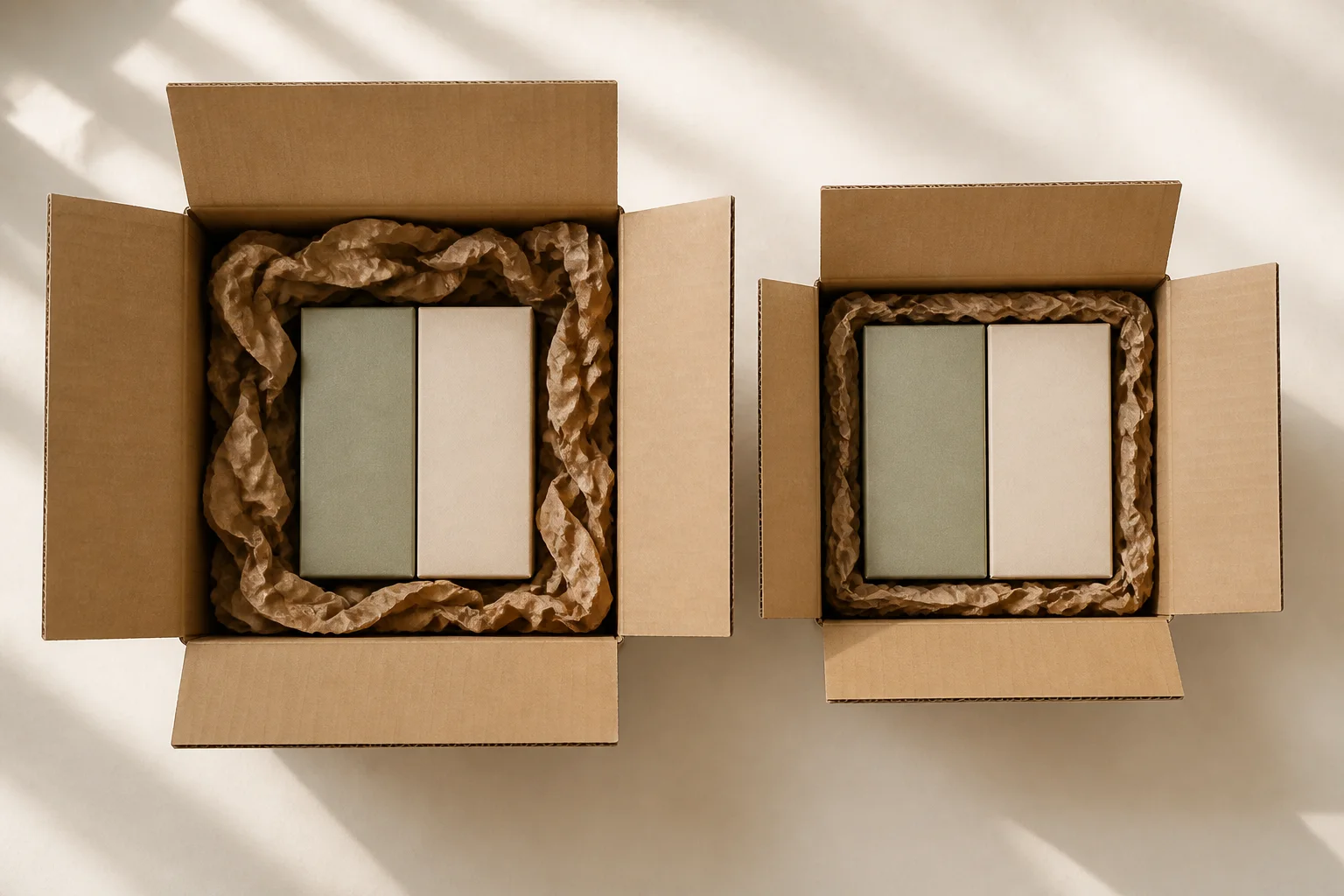
Right-size packaging is not the smallest box you can force a product into. It is a shipping pack that protects the order, uses space sensibly and can be packed consistently—with a manageable number of carton sizes on the shelf.
Two Reddit questions capture the trade-off. One seller describes spending too much time cutting boxes down while lacking space for many sizes. Another asks how to fit mixed-product orders while stocking as few shipping box sizes as possible. These are individual experiences, not a survey, but they point to a useful planning question: which order patterns deserve their own box? [1] [2]
1. Choose ecommerce box sizes around orders, not just products
A store with many products does not necessarily need many cartons. Several small items may share a footprint; a popular bundle may need a different layout from its individual components. Counting product SKUs misses both relationships.
Take a representative run of completed orders. Include ordinary weeks and important bundles or promotions. Group orders by the items packed together, quantities, permitted orientation and protection needs. If you are pre-launch, use plausible baskets and label the assumptions so you can replace them with actual orders later.
For each group, record the current box, packed weight, outside dimensions, cushioning and time to pack. Note awkward exceptions: a long accessory, an upright-only container, a gift sleeve that cannot bend, or two surfaces that must not rub. Do not use average product dimensions as the basis for a box; an average may describe a parcel that none of your real orders resembles.
2. Measure the protected product, not the bare item
Use two sets of dimensions for different decisions. Clear internal dimensions determine whether the protected contents fit. The measured outside dimensions of the closed parcel feed the shipping quote. Confirm the supplier's dimension convention before comparing cartons.
Build the actual pack before measuring it. Include the retail box, insert, divider, wrap, accessories and required separation. Try permitted orientations. Preserve protection rather than removing cushioning to cross a pricing boundary; there is no universal clearance that is safe for every product.
- Leave enough assembly space for packers to load the order without forcing the lid or bowing a wall.
- If a gift box needs an outer shipper, measure the complete system.
- Keep a suitable flat area for the actual shipping label and handling marks.
- Follow the carrier's current rules for outside measurement and rounding. [3]
3. Build a small box-size family with an exception path
Give each candidate carton a clear job. A useful exercise is to separate single-item orders, repeat bundles and larger mixed baskets. That is a way to organize a trial—not a recommendation that every business stock exactly three sizes.
| Order pattern | Candidate box role | Main check |
|---|---|---|
| Frequent single item | Compact standard carton | Protected fit and label area |
| Repeated two-item bundle | Shared bundle footprint | Divider and packing speed |
| Similar footprint, varied quantity | Two heights or multi-depth | Adjustment time |
| Rare long or fragile order | Documented exception | Protection without oversizing common orders |
Assign sampled orders to a candidate box only after confirming physical fit. Track how many orders each size serves. Keep a fallback for unusual orders and stockouts; without one, packers may improvise or reach for the largest box every time.
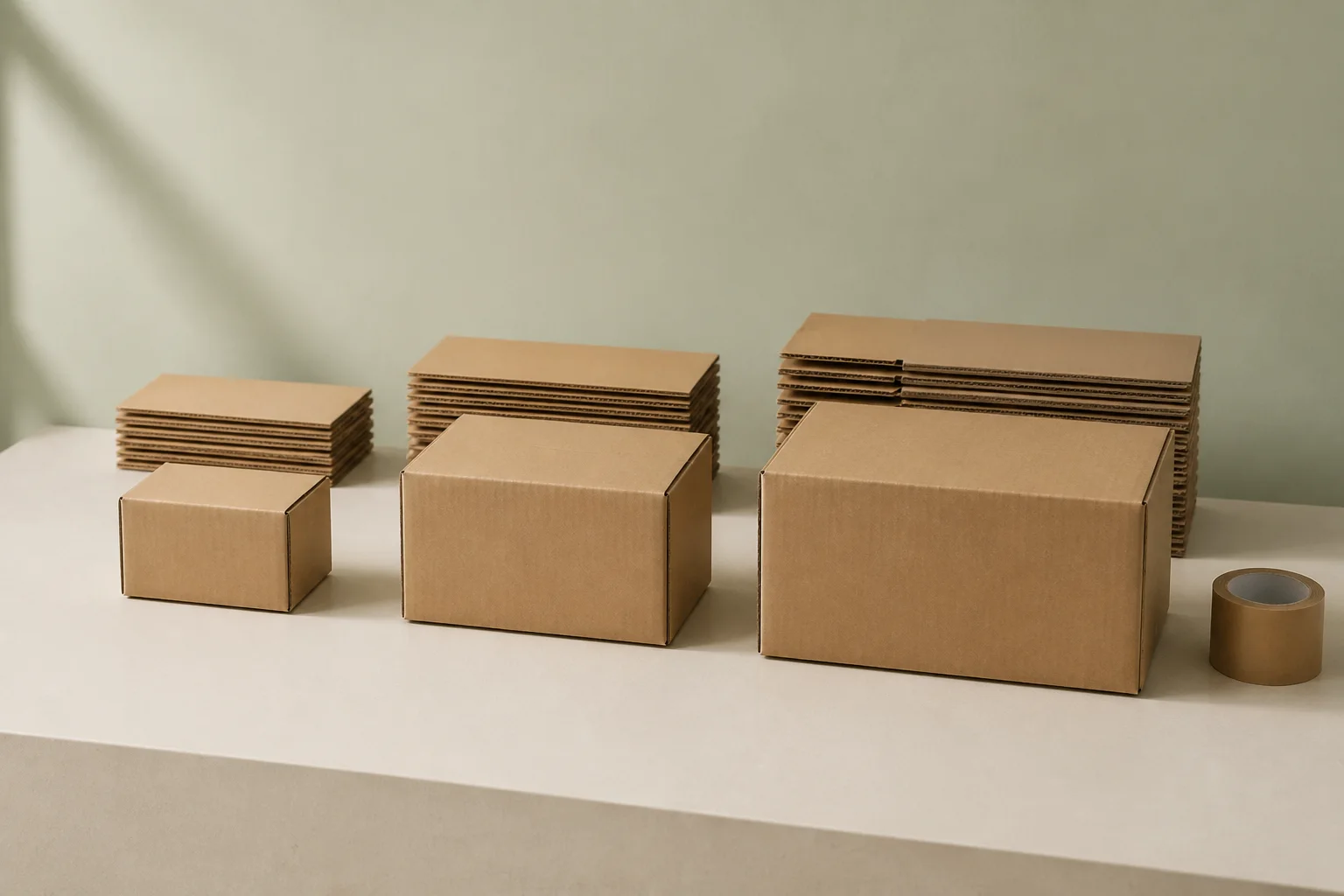
4. Check dimensional weight before assuming shipping savings
Dimensional weight relates a package's volume to a weight used for pricing. FedEx explains that applicable shipments are charged using dimensional or actual weight, whichever is greater. Smaller outside dimensions can help when dimensional weight is the limiting factor. [4]
The relationship is length × width × height divided by the applicable DIM divisor. Use consistent units and the carrier's current rules. Do not copy a divisor from a forum into every quote: service, market and rate arrangement matter. UPS's US guidance, for example, distinguishes divisors by rate type. [3]
| Candidate | Outside dimensions | Volume |
|---|---|---|
| Original carton | 12 × 10 × 8 in | 960 in³ |
| Lower-height candidate | 12 × 10 × 6 in | 720 in³ |
The second example has 25% less external volume: (960 − 720) ÷ 960. That does not mean a 25% lower shipping bill. Actual weight may govern, the parcel may stay in the same pricing band, or other charges may dominate. Requote each fully packed candidate using the same service and account; keep carton, cushioning and labor costs beside the freight quote.
5. Consider multi-depth boxes when height is the real variable
Multi-depth boxes provide alternative fold heights within one design. They are worth evaluating when orders share a similar length and width but vary in height. Confirm the supplier's intended resizing and sealing method. They help less when the footprint changes substantially, and extra folds still take time.
Compare an adjustable design with two ready-to-use heights. Time both approaches using the same order mix. The adjustable option may simplify stock, while dedicated sizes may pack faster. If your team already cuts down boxes, record that work rather than treating it as free.
6. Run a packing trial before changing the whole range
Ask the people who fulfill orders to pack representative baskets using the current and proposed cartons. Include a difficult mixed order and a stockout fallback, not just the easiest single item.
- Fit and protection: contents stay controlled, walls do not bulge and the closure works.
- Handling: record assembly, loading, resizing, sealing and rework time.
- Materials: record carton, divider, tape and void-fill use.
- Parcel data: measure sealed outside dimensions and total weight.
- Inventory: check flat-stock space and whether staff can distinguish similar sizes.
A bench trial does not prove transit performance. Validate the complete pack for the intended route before rollout. After launch, watch actual carton use, freight adjustments, packing time, damage and return reasons. Revisit the range when the order mix changes.
7. Send a box-size brief that a supplier can act on
Include these details
- Recurring order combinations and frequency.
- Product dimensions, weights and allowed orientations.
- Required cushioning, dividers and presentation constraints.
- Current internal carton sizes and sealed outside dimensions.
- Assembly method, storage space and current resizing work.
- Expected quantity per proposed size and delivery route.
Ask for proposals tied to the order groups, with dimensions labeled as internal or external. Compare custom mailer box options where the structure suits the product. For purchasing quantities, see our small-business packaging guide; once the structure is chosen, use the sample approval checklist.
Frequently asked questions
How many shipping box sizes should an ecommerce store stock?
There is no universal number. Group recurring order combinations, trial a small suitable set and add a size only when the protection, packing-time or delivered-cost benefit justifies extra stock.
Does a smaller shipping box always cost less?
No. It may reduce dimensional weight, but the rate can stay unchanged when actual weight governs or the parcel remains in the same pricing band. Requote the complete pack.
When are multi-depth boxes useful?
They are candidates when orders share a similar footprint but need different heights. Time the extra handling and validate protection in each configuration.
Sources & editorial notes
Reddit threads informed the buyer questions, not market estimates or technical standards. This is a qualitative guide, not a representative survey. Carrier guidance was reviewed on August 26, 2026; check current terms.
A clearer box-size brief
Start with your most common order.
Share the product dimensions, bundle combinations, protective needs and quantities with Triya Gift to discuss a practical packaging configuration.
Discuss your packaging sizes