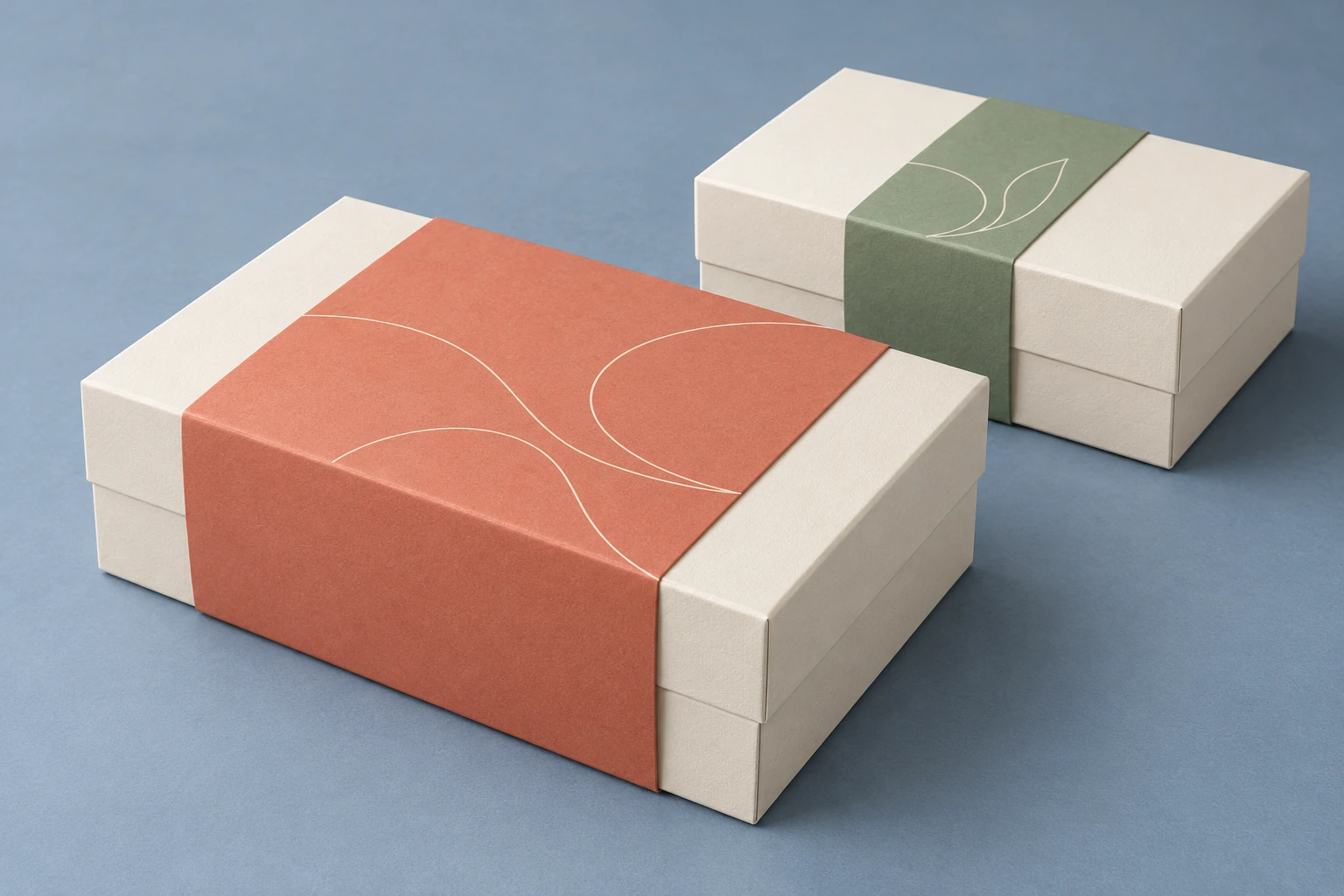
How do you size a paper sleeve for a gift box?
Measure the finished, closed box along the exact route the sleeve will wrap. Record the box’s outside dimensions, the sleeve coverage and the intended seam. Use a paper-strip mock-up to establish a starting fit, then approve a sample in the proposed stock and finish. Check both application and removal: the sleeve should meet the agreed handling requirement without scraping the box or slipping off during normal pack-out.
First, agree on what “sleeve” means
A belly band is a relatively narrow strip wrapped around a product or box. A paper sleeve usually covers more of the outer box and is open at its ends. Suppliers sometimes use the names interchangeably. Specify a drawing or reference photo, the visible coverage and whether the part is supplied flat or as a glued tube.
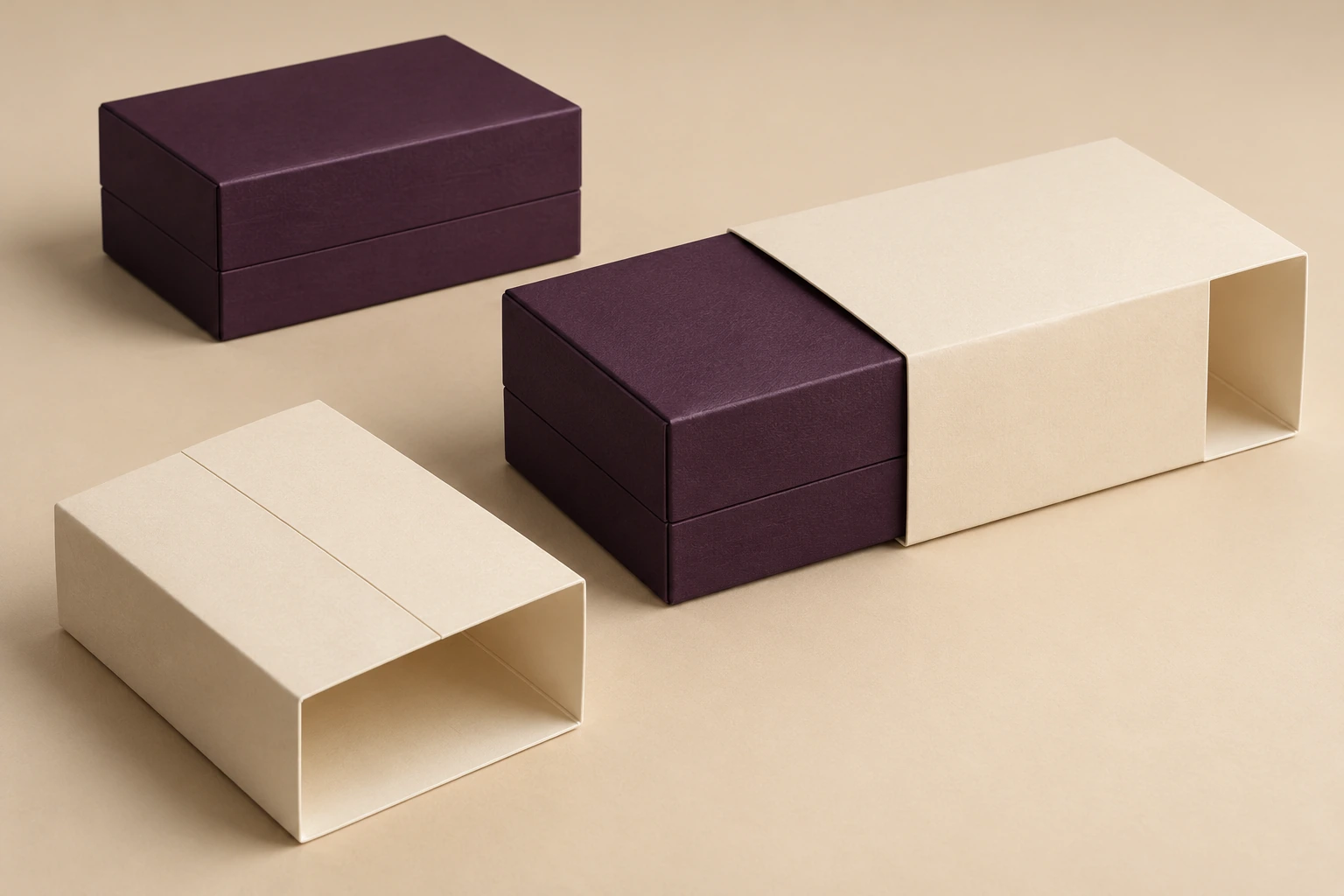
An external branding sleeve is also different from the structural sleeve of a drawer box. The drawer’s surrounding shell is part of the opening mechanism; a removable printed band around a closed gift box is an additional component. Avoid asking two suppliers to price different parts under the same name.
A Reddit packaging question about a paper “jacket” illustrates this naming problem: the buyer could describe the appearance but did not know what to request. That discussion is a useful vocabulary signal, not a technical specification. A photo and a fit brief are more reliable than a name alone.
Belly band
Leaves much of the base box visible. Discuss the seam, band position and what keeps it in place during handling.
Open-ended sleeve
Provides a larger artwork surface. Discuss the slide direction, corners, seam and access to the box closure.
Drawer-box shell
Houses the sliding tray. Assess it with the tray and contents; a branding band’s fit rule cannot be transferred to it.
Measure the actual wrap route
Start with a representative finished box: closed, loaded as intended and carrying any wrap, lid overhang, ribbon or other feature that sits underneath the sleeve. A nominal internal box size does not describe the outside surface the band must pass over.
- Mark the orientation. Draw the box front, sleeve slide direction and proposed seam location. State whether the band crosses the lid/base joint or a magnetic flap.
- Measure the outside cross-section. Record the two dimensions around which the sleeve loops. Separately record its coverage along the box. State units and identify the box revision.
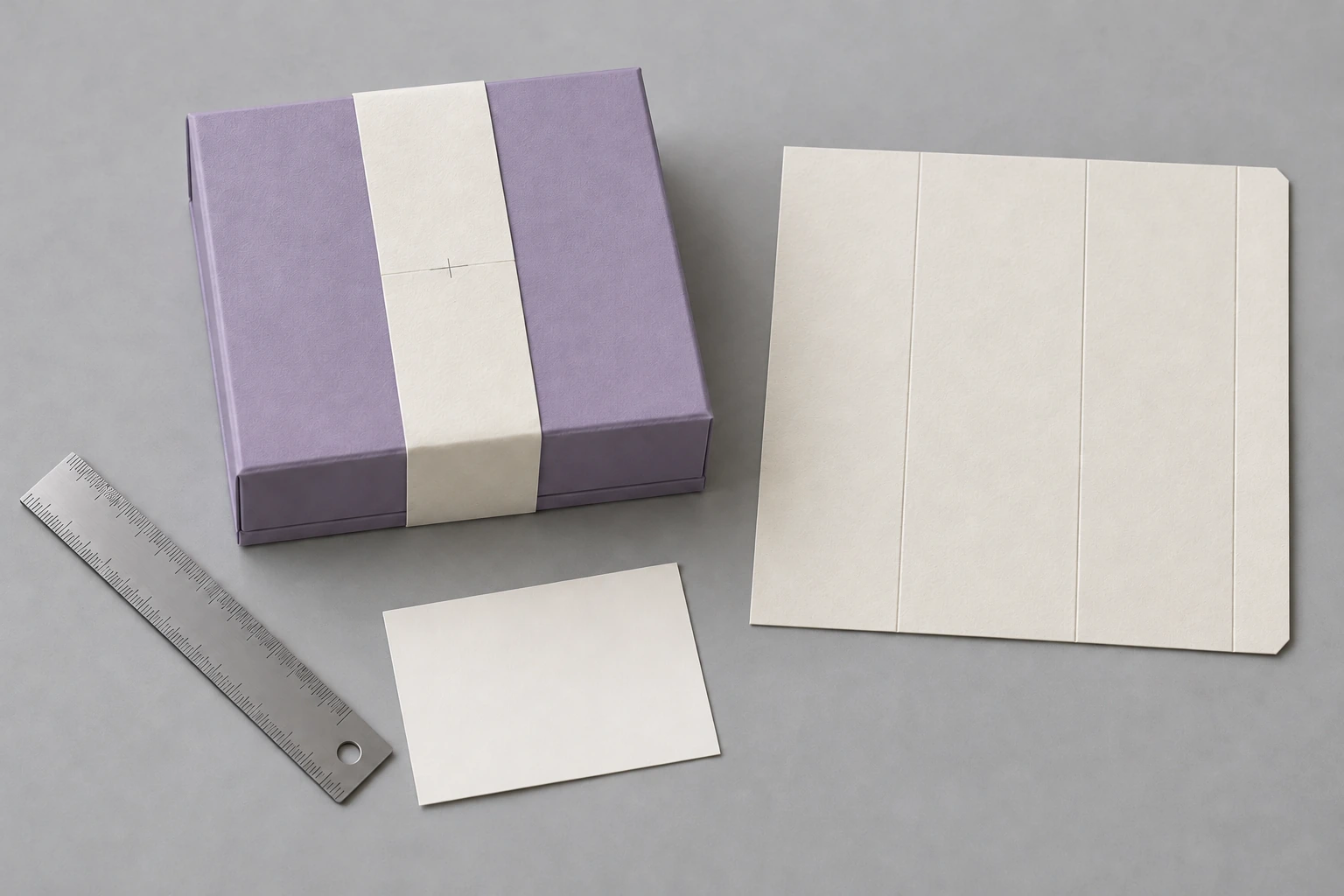
- Wrap a strip without compressing the box. Use a strip of the intended coverage where practical. Mark where the ends meet, then remove and measure it flat. Note any corner, step or projection that changes the route.
- Separate the loop from the join. The meeting mark describes the trial loop. An overlap, glue flap or locking feature is additional construction detail that the supplier must develop.
- Request a production-material trial. A thin-paper mock-up helps communicate the route; it does not establish the final paperboard length or slide clearance.
| Field | What it describes | Common confusion to resolve |
|---|---|---|
| Finished box outside dimensions | The assembled box that the sleeve will go over. | Internal usable dimensions are a different measurement. |
| Loop route and orientation | Which box faces and corners the sleeve wraps around. | The same box can have different wrap routes. |
| Coverage | How far the sleeve extends along the box. | Do not call both coverage and total flat length “width.” |
| Flat blank and fold positions | The supplier-developed cutting and creasing layout. | A strip meeting mark is not an approved dieline. |
| Join or closure | Overlap, adhesive area, lock or other connection. | Confirm which dimensions include the join. |
| Stock and finish | Material identity, thickness and surface treatment. | GSM alone does not define thickness or folding behavior. |
Choose how the sleeve closes and how the buyer opens it
A pre-glued tube slides onto the box during packing. A flat band joined during packing is wrapped around it and closed at the workstation. A locking construction uses a developed tab or interlock. Each option changes assembly work and the sample that needs approval; none should be selected from appearance alone.
Place the join where it can be made consistently without covering required information or interfering with the intended reveal. Keep adhesive away from the decorative box surface unless attachment to the box is deliberately specified and reviewed. A band crossing a lid joint may need to be removed before opening; explain that sequence to the recipient.
For creased paperboard, ask the converter to confirm stock, grain direction and crease setup together. Holmen’s Graphics Handbook explains the role of creasing before folding. Its technical information defines machine and cross-machine grain directions. These sources support reviewing material and conversion together; they do not supply a universal clearance for your box.
Approve the complete sleeve-and-box pair
Use the proposed paper, print, finish and closure on the actual finished box. A sleeve that works on an undecorated blank may behave differently on a wrapped, textured or finished surface. Refer to the GSM and paperboard thickness guide when specifying material, and the dieline checklist when reviewing the developed artwork.
| Check | Repeatable observation | Record and agree |
|---|---|---|
| Application | Fit the sleeve using the intended workstation method, without forcing it. | Any snag, corner distortion, seam stress or awkward handling. |
| Position | Place the loaded pack in the orientations used in your packing route. | Whether the sleeve moves from its specified position; the acceptable movement must be agreed. |
| Removal | Remove it in the stated direction and inspect both surfaces. | Drag, scuffing, color transfer, torn edges or a confusing opening step. |
| Closure | Inspect the join before and after the handling sequence. | Lifted seam, visible adhesive, misalignment or unexpected separation. |
| Artwork | View the assembled pack on every selling face. | Fold interference, covered information and alignment with the approved proof. |
For a reproducible record, identify the box, sleeve and artwork revisions; record stock and finish, sample count, operator, date, application/removal sequence and observed issues. Photograph the same faces before and after. Agree acceptance criteria against a retained reference sample. This is a proposed review method: no internal measurements, tested tolerances or performance results are claimed here.
If you need a measured pull or slide force, ask the supplier or laboratory to define the instrument, fixture, speed, repetitions and reporting conditions before setting a limit. “Snug” is a useful starting description, but it is not a numerical acceptance criterion.
Pair the sleeve with the right base box
- Lid-and-base gift boxes: check lid overhang and whether the sleeve bridges the joint. Review the closed assembly.
- Magnetic rigid boxes: check the flap, ribbon and opening direction before positioning the sleeve or band.
- Custom mailer boxes: decide whether the decorative sleeve travels inside a protective shipper or forms part of the visible parcel. Assess the complete distribution pack.
Triya Gift can discuss a base-box and printed-wrap brief using your actual dimensions and artwork. Confirm sleeve availability, construction, quantity, sample cost and timing separately; a box’s MOQ or lead time is not automatically the sleeve’s commercial term.
Buyer questions
Can I order a sleeve from the internal box dimensions?
No. Supply the finished outside dimensions, wrap orientation and a representative box. Internal capacity alone does not define the surface the sleeve must fit.
How much clearance should I add?
There is no single allowance established by this guide. Ask the converter to develop the flat dimensions for the specific stock, finish, seam and box variation, then approve the fit on samples.
Is a paper sleeve tamper-evident?
A removable sleeve alone does not establish tamper evidence. If evidence of opening is required, define the intended function and evaluate a specific closure with the appropriate reviewer.
Does a belly band replace a shipping box?
Do not assume so. A decorative band is a presentation component; shipping protection depends on the complete loaded pack and its distribution conditions.
Will using a sleeve always cost less than printing the box?
No. Compare the base box, sleeve printing, setup, joining, application labor and delivered quantities in written quotations. Savings require actual quotes and operating data.
From fit idea to sample brief
Send the box dimensions and the opening you want.
Share the finished box dimensions, sleeve coverage and direction, seam preference, artwork, stock/finish references, quantities and destination. Ask Triya Gift for a box-and-sleeve feasibility review and a sample proposal.
Request a box-and-sleeve reviewScope: External paper sleeves and belly bands around secondary gift packaging. Direct food contact, regulated labeling, tamper evidence and transport validation need separate review. Images are original illustrative packaging concepts. Sources inform vocabulary and paperboard conversion; the fit workflow is a proposed buyer method, not a factory test report.