MATERIAL REFERENCE / 30 SEPTEMBER 2026
GSM is not
box thickness.
A buyer's guide to grammage, caliper and the layers inside a custom box.
DIRECT ANSWER
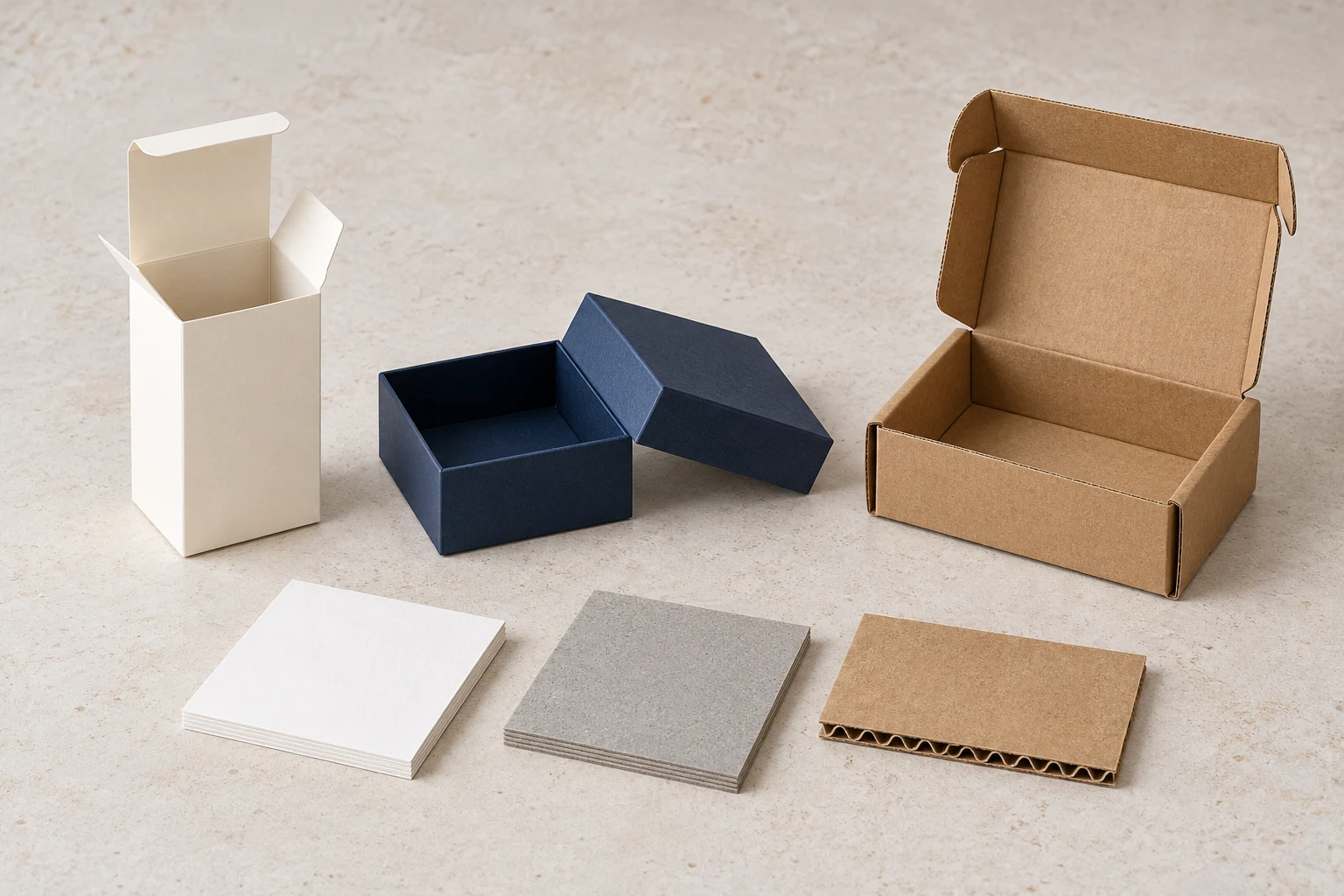
GSM measures mass per unit area, while caliper measures thickness. You cannot reliably convert one into the other without information about the board's density or bulk. For custom boxes, specify the material grade, grammage and thickness separately, then identify coatings, wrapping layers and the measurement method. Compare a complete material specification and assembled sample—not an isolated GSM number or a photograph.
Reddit questions about box materials repeatedly mix up a heavy sheet, a thick sheet and a rigid finished box. A 2026 discussion about measured papers also challenges the assumption that higher GSM always gives proportionally greater thickness. These discussions identify a useful buyer question, not a verified performance benchmark: what exactly does the supplier's number describe?
Use this guide for: comparing paper and paperboard specifications for gift boxes and cartons. Corrugated board requires its own construction and test information. This is a purchasing reference, not a material certification, laboratory procedure or promised strength rating.
Read the units before comparing the quotes.
| Term | What it describes | What it does not establish |
|---|---|---|
| Grammage / GSM, g/m² | Mass of material per unit area | Thickness, stiffness or finished-box load capacity |
| Caliper, µm or mm | Thickness under defined measurement conditions | Material identity or complete transit performance |
| Apparent density / bulk | Relationship between mass, area and thickness | An automatic quality ranking |
| Board grade and construction | The specified material and its layers | That two different suppliers' descriptions are interchangeable |
| Finished wall thickness | The assembled wall, including specified layers | The thickness of the bare structural core alone |
ISO 536 covers determining grammage. ISO 534 covers thickness and related properties for paper and board; its published scope excludes corrugated fibreboard. Quoting a standard number does not mean a supplier has tested your sample or holds a certification.
A USEFUL RELATIONSHIP
Why no universal GSM-to-mm chart works.
Paperboard makers can produce different combinations of mass and thickness. Holmen Iggesund's paperboard reference explains how grammage and thickness relate through density and bulk. A board with higher bulk can be thicker at a given grammage.
Illustrative arithmetic only: 400 µm ÷ 300 g/m² ≈ 1.33 cm³/g. These are hypothetical inputs, not a Triya Gift material specification or measurement.
Do not use this relationship to infer stacking strength or select a shipping box. It explains the units; it does not replace structural design or performance testing.
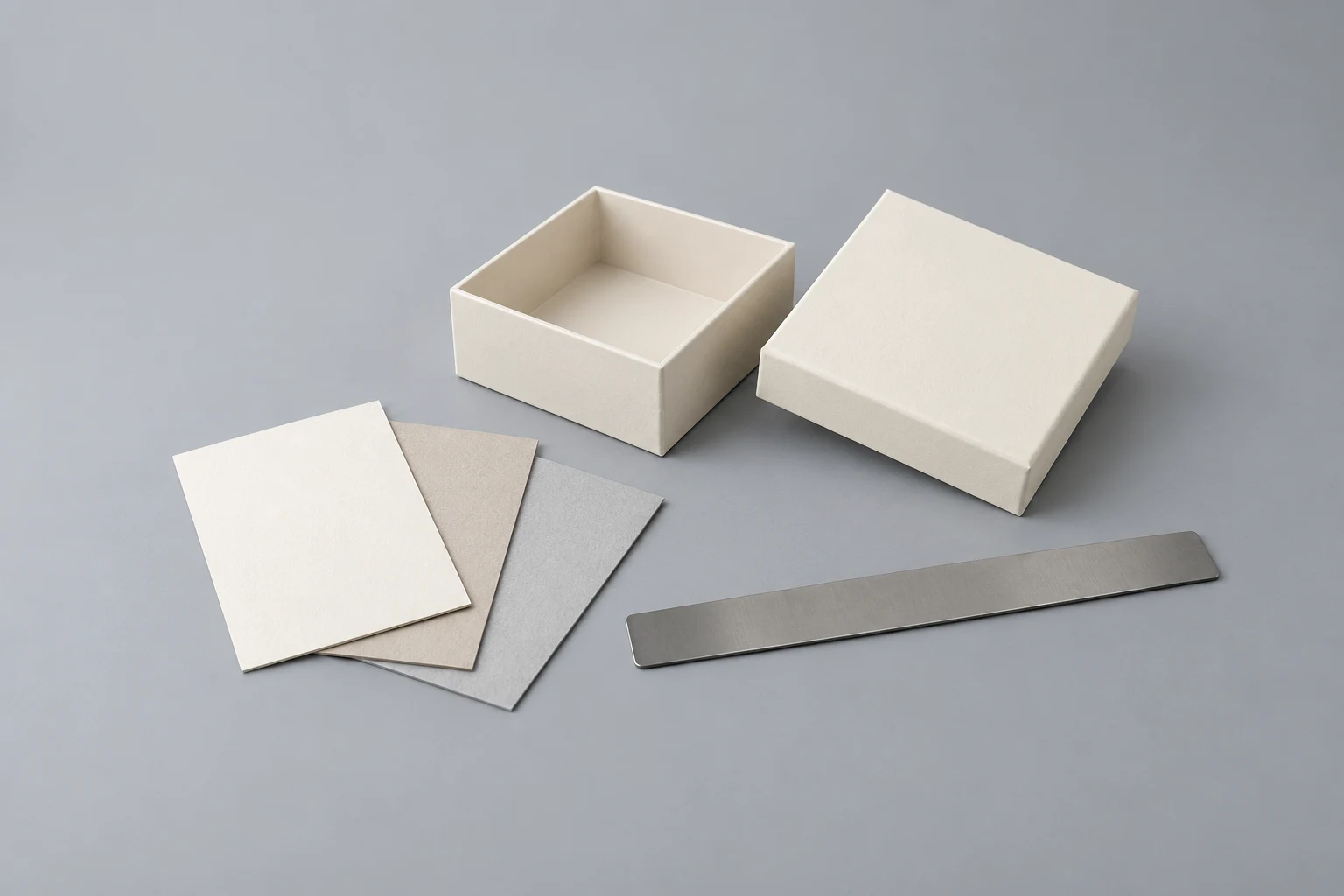
Specify the core and the surface separately.
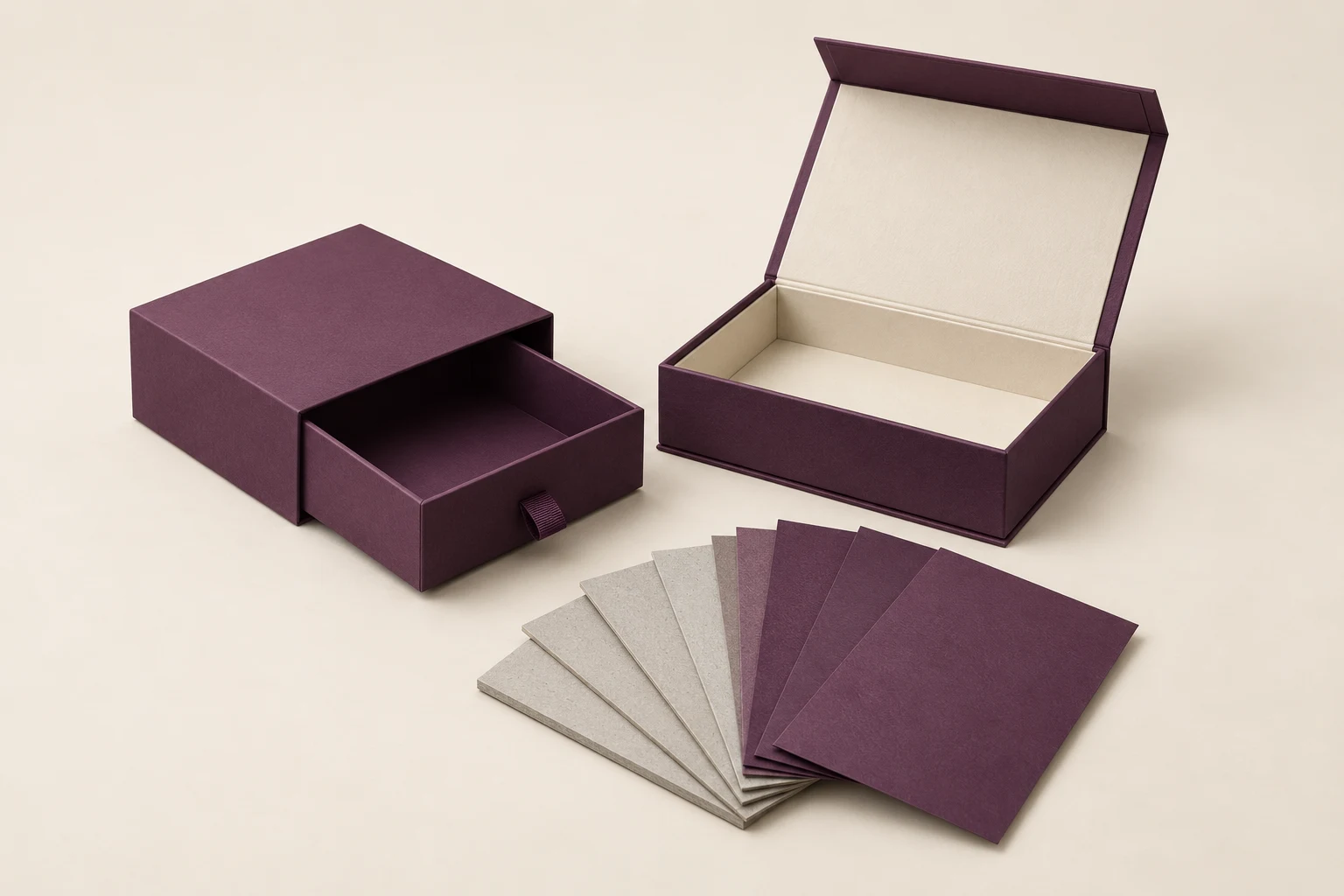
For a magnetic rigid box, the paper you see is not necessarily the board providing the structure. Identify the greyboard core, outside wrap, inside lining and any coating separately. Ask whether a thickness figure refers to bare core or the finished wall. Keep adhesive and finishing details in the construction record rather than treating the layers as interchangeable.
The same distinction matters for a drawer box: changing the core or wrap can affect how the tray fits the sleeve. Approve the assembled fit after a material substitution. For a corrugated mailer, request the flute, liner and medium specification and agreed performance evidence; a single total GSM number is not a substitute for those details.
BUYER WORKSHEET
Turn a vague material description into a comparison record.
| Ask the supplier for | Record against each proposed material |
|---|---|
| Exact identity | Grade or reference, producer if known, batch/sample ID and applicable data sheet |
| Separate quantities | Nominal grammage and caliper, units, tolerances and which layer each value describes |
| Surface build | Coating, lamination, printing, wrap and lining references; supplied versus finished condition |
| Measurement basis | Method, instrument, conditioning and whether values are nominal, supplier-tested or independently measured |
| Acceptance | Agreed comparison criteria, actual-product fit, approver and retained sample revision |
Request missing information rather than marking an incomplete quote as equivalent. Compare tolerances and methods as well as nominal values. A quoted target and a reading from one piece of board are different kinds of evidence.
A repeatable sample-review workflow.
- Label before measuring. Assign each material a sample ID and photograph its surfaces and edges. Record whether it is raw stock, coated stock or a finished wall.
- Agree the method. Ask the supplier or laboratory to state conditioning, instrument and measurement procedure. A ruler or hand-squeezed caliper check is not automatically equivalent to a controlled paper-thickness test.
- Keep raw observations. For an indicative grammage calculation, mass in grams divided by accurately measured area in square metres gives g/m². Retain mass, area, instrument resolution and specimen identity. Formal acceptance testing should follow the agreed complete method.
- Review the finished construction. Trial folding, closure and product fit with the specified layers and finish. Treat a board change as a revision requiring review, not as an automatic like-for-like replacement.
- Retain the decision. Keep readings, conditions, photos, supplier data and approval together. Define the sampling plan and tolerances before checking an order.
This is a proposed data-collection workflow, not internal test results. No universal GSM, thickness or pass tolerance is recommended here. For the wider release process, use our sample approval checklist.
Material questions, answered.
Is a higher GSM always a better box?
No. Evaluate the material, construction, dimensions, contents and intended route together. More mass does not by itself establish the performance your pack needs.
Can I specify just “2 mm board”?
That is incomplete. Identify the grade, layer, tolerance, measurement basis and surface build. Also clarify whether the number refers to bare core or the finished wrapped wall.
Can a supplier identify my material from a photo?
A photo can support an initial discussion, but it does not establish grammage, thickness or construction. Send a physical reference where possible and ask for a documented proposed match.
Does naming ISO 534 certify my packaging?
No. A method reference describes how a property may be measured. Ask for an applicable test record and do not apply it outside its scope.
FROM MATERIAL TO FINISHED PACK
Bring the sample.
Define the specification.
Send Triya Gift your box style, product dimensions and weight, quantity, reference material and finish requirements. Ask for the proposed core, wrap, lining and sample plan with clearly separated units. We can then discuss a packaging quotation against a more complete brief.
Request a material-and-box quote ↗