Tissue Paper for Gift Boxes: Preventing Color Transfer Starts with the Contact Layer
By Triya Gift Packaging Team · Published and updated October 29, 2026
The direct answer
Choose tissue paper for gift boxes by its contact with the actual product, not by color or an “acid-free” label alone. Identify which sheet surface touches the item, request evidence for the relevant paper and print, and trial the complete wrap under agreed handling and environmental conditions. Keep decorative color separate from sensitive surfaces until compatibility is confirmed. Tissue is not a substitute for product retention or moisture protection.
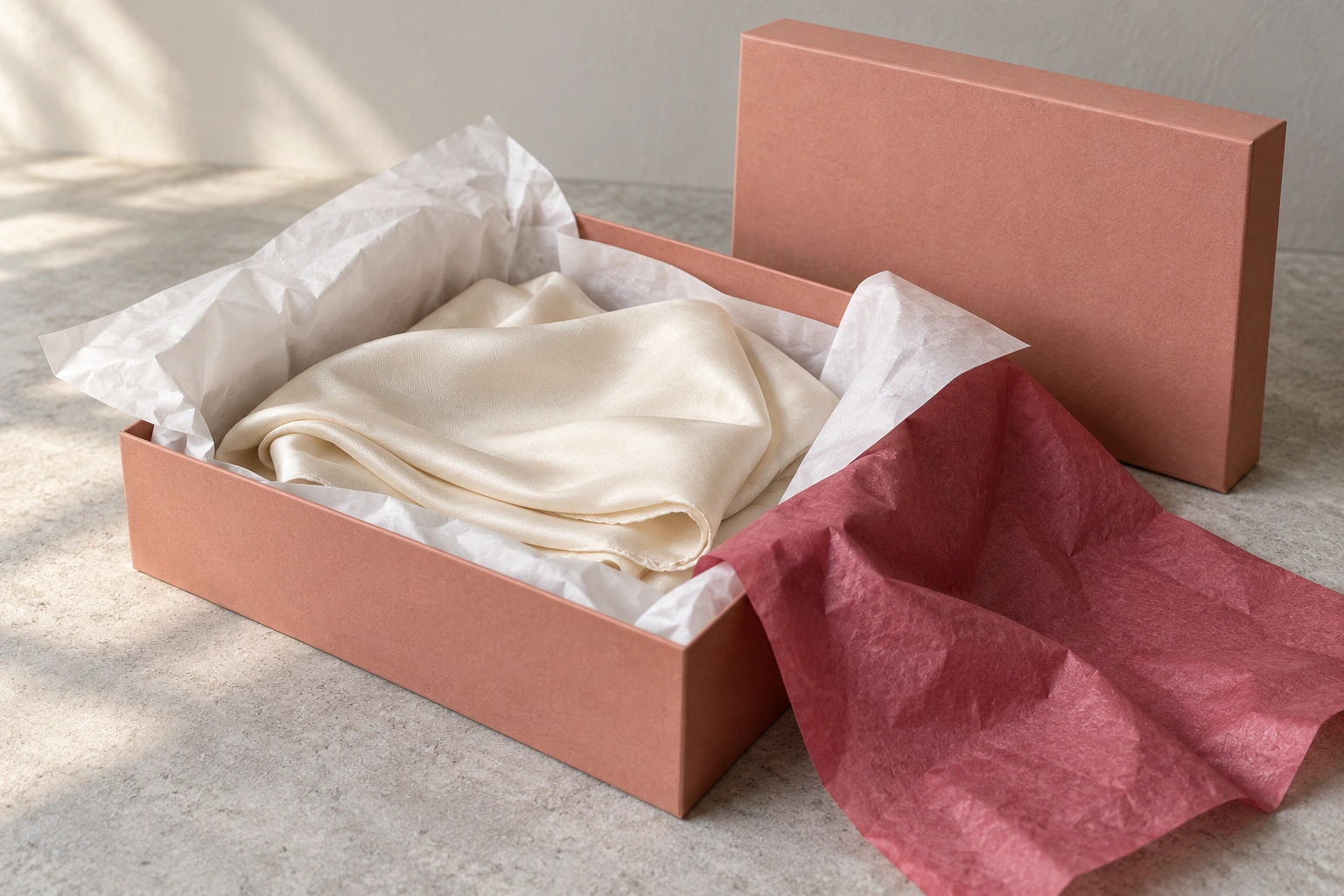
Applicability: Secondary gift packaging for non-food products, including textiles, accessories and separately packaged items. This guide does not establish food-contact compliance, archival suitability or a waterproof packaging specification. Images illustrate proposed arrangements, not material-test results.
One decorative sheet can become a product-contact material
Tissue often starts as a finishing touch: a folded layer, a color reveal or a place for a repeating brand pattern. Once it touches the product, however, it is part of the contact specification. A pale scarf, a coated carton and a smooth container do not necessarily respond to the same wrapping material in the same way.
A Reddit small-business discussion describes combining plain boxes with decorative tissue. Separately, a buyer report about a wet delivery describes black tissue staining a dress. These are qualitative accounts, not a failure-rate study. Their useful question is practical: what is touching the product, and has that combination been reviewed?
Define three layers in the brief:
- Contact layer: the material directly touching the product or its primary pack.
- Presentation layer: the visible tissue, printed pattern or colored fold that supports the unboxing.
- Distribution layer: the shipping pack and any separately specified protection required by the delivery route.
One component can perform more than one role, but do not assume it does. Tissue used for appearance does not automatically prevent movement, abrasion or water exposure.
Separate the claims before comparing quotations
“Acid-free,” “bleed-resistant” and “protective” answer different questions. Ask the supplier to identify the relevant property and its supporting specification instead of treating them as interchangeable quality labels.
| Description on a material proposal | What to ask | What the description does not settle |
|---|---|---|
| Acid-free | Which material is covered, and what specification supports that description? | Whether the finished dyed or printed sheet transfers color in your intended use |
| Buffered or unbuffered | Is a buffer present, and is the tissue appropriate for the actual object and intended storage? | Whether the paper is suitable for every textile, finish or long-term storage requirement |
| Bleed-resistant or colorfast | Under which contact, moisture and handling conditions was that property evaluated? | An unrestricted no-transfer guarantee across every product and environment |
| Printed tissue | Which face contacts the product, and which substrate, ink and print coverage are included in the sample? | That an unprinted-paper report covers the finished printed sheet |
| White or natural-colored tissue | What is the actual stock, finish and contact suitability? | Universal compatibility, waterproofing or absence of all marking risks |
For a useful distinction between material types, TALAS explains buffered and unbuffered storage materials, including why object composition matters. That conservation guidance is not a validation of a commercial gift pack. If preservation or a sensitive textile is part of the brief, involve an appropriate material specialist rather than applying an ordinary gift-wrap specification to it.
Compare arrangements, not only paper colors
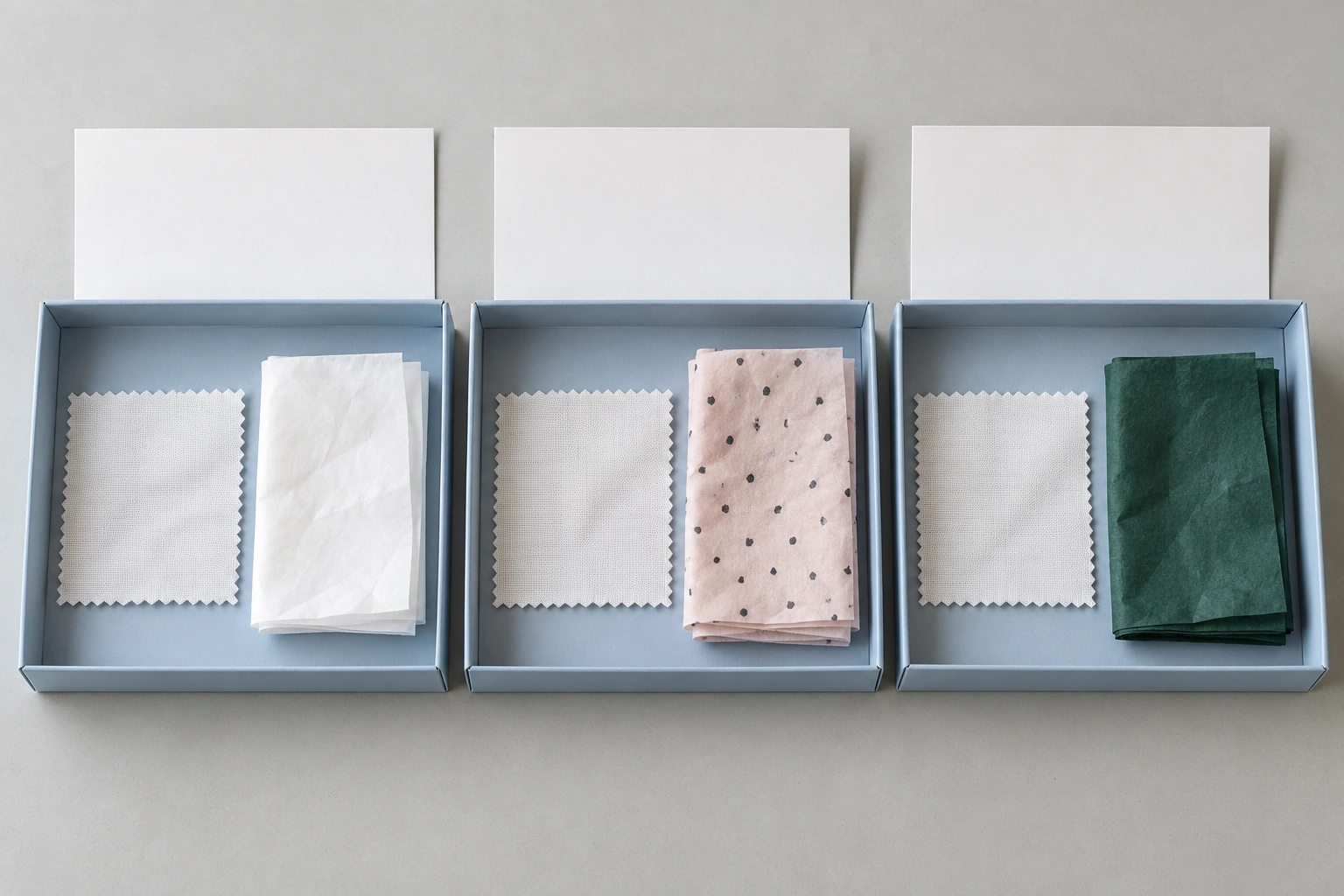
Begin with the product surface, then decide where the decorative element sits. The arrangements below are starting points for review—not approvals of particular materials.
| Arrangement | When it is worth evaluating | Specific sample question |
|---|---|---|
| Unprinted contact wrap with a separate colored outer sheet | Pale goods or surfaces for which color transfer is a concern | Can the decorative sheet move into contact during packing, storage or opening? |
| Printed tissue directly against a primary carton | The product is already contained and the carton finish can be evaluated | Does either printed surface mark, stick to or abrade the other? |
| A small decorative fold above a fitted insert | The insert handles location and the tissue mainly contributes presentation | Does closing the lid push the fold against a sensitive surface? |
| Tissue around an already specified protective pack | Presentation is added outside a separate product-protection system | Does the wrap interfere with sealing, inspection or recipient instructions? |
Using an unprinted contact layer can separate the decorative choice from the contact material, but it is not an automatic barrier solution. Confirm the contact sheet itself and check whether colored areas can migrate into contact. Do not add unnecessary layers simply to avoid asking for a suitable material.
A repeatable sample review before the first packing run
Use sacrificial representative samples, not saleable goods or irreplaceable items. Agree the review with the packaging supplier and the product owner before exposing the materials to any special condition. This workflow produces an observation record; it is not a standardized laboratory test.
Record the contact pair
Identify the product or representative surface, its finish and condition, the tissue supplier reference, color, print face and batch if available. Include the box lining, insert and any sticker or ribbon that can touch the same surface. Retain an untouched product sample and tissue sample for comparison.
Reproduce the intended wrap
Use the proposed sheet size, folds, closure and packing orientation. Photograph which surfaces meet. Close the loaded box and check whether pressure from the lid, a divider or a neighboring item changes the contact map. Avoid specifying sheet size from the empty box alone: the actual gift and the packing sequence determine the wrap.
Agree the exposure and handling conditions
Write down the duration, temperature and humidity to be reviewed, how they will be measured, and the number of samples. If a separate moisture-exposure review is needed, have a competent supplier or laboratory define it and report it separately. Do not wet a customer product or assume an improvised water-drop check represents a distribution route.
For a controlled handling comparison, agree the contact surfaces, load or pressure arrangement, movement and repetition count before the review. Keep these conditions consistent between candidates. If quantitative color transfer or rub performance is required, request an appropriate laboratory method and agreed acceptance criteria; do not invent a pass grade from a photograph.
Compare, document and decide
Inspect the contact areas against the untouched control under the same lighting. Record visible transfer, sticking, tearing, surface marking and changes in appearance. Note where each observation occurred. An absence of visible marks in one trial does not prove suitability for every condition or a later material revision.
| Sample record field | Why it belongs in the approval file |
|---|---|
| Product, tissue and print revisions | Identifies the combination actually reviewed |
| Contact face, fold pattern and box/insert reference | Makes the pack-out repeatable |
| Sample count, controls, operator and date | Defines the scope of the observation |
| Exposure, duration and handling sequence | Prevents comparisons between unlike conditions |
| Before/after photographs and issue location | Supports a specific approval or revision discussion |
| Acceptance criteria, decision and retained sample | Records what production should match |
Use our packaging sample approval checklist for the wider approval process. For marks involving the box surface itself, the black gift-box scuff guide addresses a different part of the contact problem.
Match the wrap to the Triya Gift box structure
With a lid-and-base gift box, check tissue overlap and the space below the lid. A neatly wrapped sample should still close without trapping excess paper in the lid fit.
With a magnetic rigid gift box, check the hinge and closing flap. Keep loose edges clear of the intended opening and ensure the recipient can reach the product without pulling against the closure.
With a custom mailer box, treat tissue as one part of the loaded pack. Establish product retention and any required distribution protection separately. A decorative fold is not evidence that a parcel is waterproof or transport-tested.

Buyer questions
Does acid-free tissue guarantee that no color will transfer?
Do not use that label as the only acceptance evidence. Ask separately about the finished sheet's dye or print behavior against your actual contact surface under agreed conditions.
Should every gift box use white tissue?
No universal choice is established here. Unprinted tissue is a candidate to evaluate when decorative color contact is a concern, but white tissue still needs appropriate stock and contact review. A colored exterior layer may provide the visual effect without being the intended contact layer.
Is printed tissue suitable for wrapping food?
This guide does not cover direct food contact. Use a separately specified primary food pack and obtain evidence for the intended use. Neither a decorative appearance nor an acid-free label establishes food-contact suitability.
Can tissue replace an insert?
Not by assumption. If the product needs a fixed position or separation, develop that requirement through the structure or an appropriate insert. Include tissue in the final sample because it can change fit and access.
Can a tissue change be approved without another pack-out review?
A change of stock, dye, ink, print coverage, finish or supplier can change the contact combination. Identify what changed and repeat the affected review before treating the new material as equivalent.
Send a complete gift-box and tissue brief
Share your product dimensions, surface or primary-pack description, preferred box opening, tissue color and artwork, contact-face plan, quantity options and destination with Triya Gift. Include a photo showing how you want the gift wrapped and flag pale, delicate or marking-sensitive surfaces.
Ask for a box-and-wrap feasibility discussion and sample proposal. Confirm tissue availability, material specification, artwork requirements, sampling cost and schedule for the actual project; box terms do not automatically apply to a tissue accessory.
Request a gift-box and tissue sample review
info@triyagift.com