
Start with a receiving decision
A bulk order can arrive weeks before a launch. The operational question is how to preserve its condition between receipt and use. Packaging discussions on Reddit raise humidity and changing material behaviour as practical concerns. Those conversations help identify the question; material guidance and your box supplier should define the response.
Scope: unused paper-based rigid gift boxes, drawer boxes and flat mailers. This guide does not establish food-contact hygiene rules, a shelf-life guarantee or an environmental specification for your product. The workflow below is a proposed receiving and storage method, not a record of Triya Gift test results.
| At receipt | Record | Next action |
|---|---|---|
| Outer cartons appear dry and intact | Order, batch, carton count, location and arrival photos | Inspect the agreed sample before releasing the batch to storage. |
| Cartons feel cold after transit into a warmer room | Arrival conditions and whether wrapping is intact | Follow the supplier's acclimatization instructions before opening; do not guess a universal waiting period. |
| Wet stains, crushed corners or unusual odour | Affected carton IDs, visible damage and photos | Segregate affected stock and request a disposition decision before packing customer products. |
| Fit differs from the approved sample | Lid or drawer behaviour, location and number inspected | Retain samples and ask the supplier to investigate material, construction and exposure history. |
Humidity, condensation and acclimatization
Relative humidity describes how close air is to saturation at its current temperature. Condensation occurs when a surface is cold enough for moisture from the surrounding air to collect. Acclimatization means allowing packaged material to reach the conditions needed for handling before removing its protection.
Holmen's paperboard handling guidance describes moisture-related dimensional changes and precautions when cold board enters warmer surroundings. It also recommends protecting unused material again after opening. Its guidance concerns specified paperboard products and operations; ask your converter which conditions apply to the finished combination of board, wrap, adhesive, coating and insert.
Do not turn a paper mill's storage time or printing-room humidity range into a warranty for a magnetic gift box. Ask for written limits for the exact construction and expected storage duration. A garage, basement or loading dock may have conditions that differ substantially from the room where the packing team works.
Store each format around its vulnerable areas
Rigid presentation boxes: preserve the supplier's master-carton arrangement and surface protection. Avoid placing loose heavy items on lids or corners. Ask for a stack limit for the packed outer carton rather than inferring one from the decorative box's apparent stiffness.
Drawer boxes: keep trays and sleeves associated with their batch and configuration. Check sliding fit against the accepted reference before use. If a drawer becomes tight, record the symptom rather than trimming the sleeve or forcing the tray.
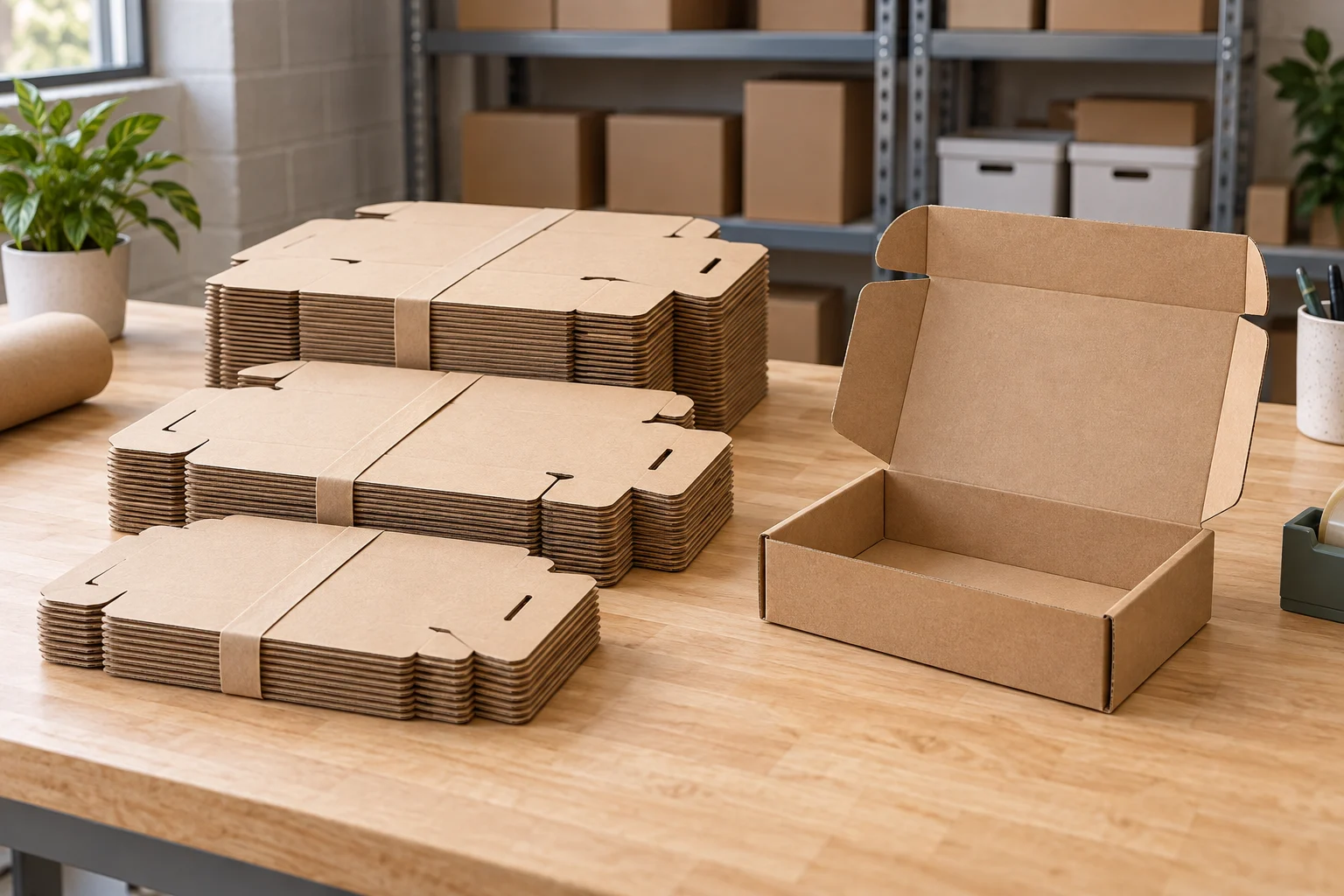
Flat mailers: keep bundles flat and supported, with fold tabs protected. Release manageable quantities to the bench and return unused blanks to the specified protection. A paper band organizes a bundle; it does not by itself provide a moisture barrier.
These handling differences are worth discussing while choosing magnetic rigid boxes, drawer boxes or custom mailers. Share available storage space and how long boxes will wait before packing, alongside the product brief.
Build a useful storage log
- Map the stock. Give each batch and shelf location a stable ID. Record receipt date, original quantity and artwork revision so older stock is not confused with newer designs.
- Measure where boxes are stored. Use a suitable temperature and relative-humidity logger near the stock. Record the device ID, accuracy specification, position and selected logging interval. Do not substitute an office thermostat reading for the storage area.
- Set limits with the supplier. Record agreed conditions and what triggers a hold or inspection. Without agreed limits, a reading is context, not proof that the boxes passed or failed.
- Repeat a documented condition check. Inspect an agreed number from identified cartons. Note warping, surface changes, closure fit and any odour. Use consistent photographs and the retained approval sample. Record how many were examined rather than calling a few boxes representative of an entire shipment.
- Rotate eligible stock. Use older approved batches first where artwork and condition remain valid. Keep held stock separate and log the person who authorizes release.
A compact record includes: batch ID, shelf, date, temperature, relative humidity, device ID, wrapping condition, inspected quantity, observation, photo reference and disposition. The log helps investigate patterns; it cannot establish a cause from correlation alone. For disputed damage or performance claims, agree a qualified testing and investigation plan.
Prepare storage requirements before ordering
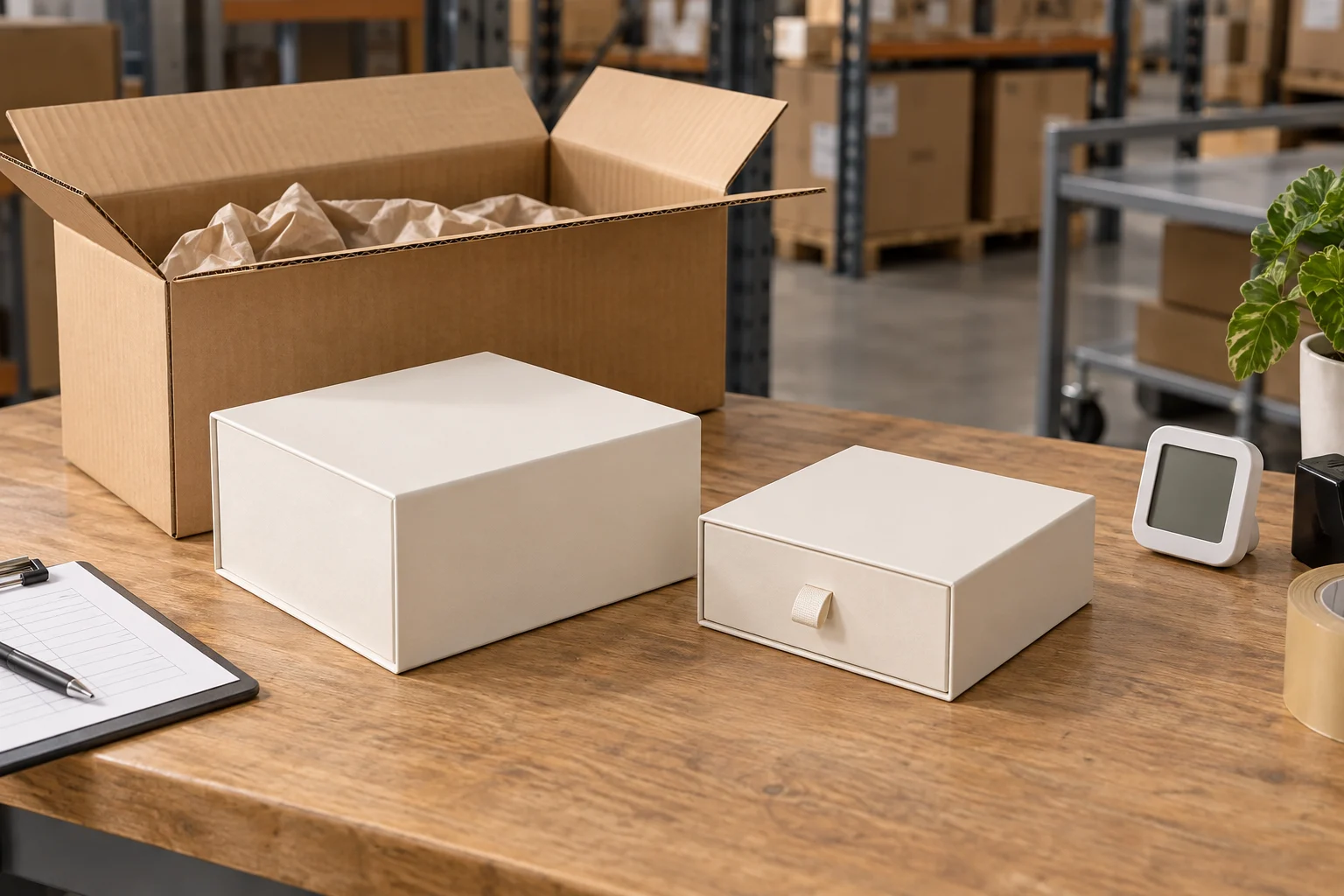
Ask the supplier to quote the packing configuration along with the box: units per master carton, external carton dimensions, packed weight, protective wrapping, stack guidance and any storage restrictions. Ask whether unused units can be rewrapped after partial picking. A lower unit price is less useful if the order cannot be stored in suitable conditions.
Keep arrival records with the approved packaging sample and record finish observations using the finish sample approval guide. This links the specification you bought to the batch you actually use.
Custom gift box storage FAQ
Can I store gift boxes in a garage?
Only if its actual conditions, cleanliness and protection meet the supplier's requirements. Measure the area through the expected storage period before relying on it for a bulk order.
Does lamination make a box waterproof?
Do not assume that it does. Edges, seams, interiors and other components still need evaluation. Request a defined performance claim for the complete box if water exposure is part of the use case.
Should I put desiccant into every carton?
Ask the supplier to specify whether it is appropriate for the enclosure and exposure conditions. Adding a packet without a defined packaging system is not a substitute for suitable storage.
How long can I store custom boxes?
Request a duration and conditions for the exact finished construction. Reinspect older batches before use, especially if materials, finish, artwork or product fit have changed.
Plan a box order that fits your storage operation
Send Triya Gift your box style, quantity, available shelf space, destination, expected storage duration and packing schedule. Request a quotation covering the product box and its master-carton packing configuration.
Request packaging and packing details