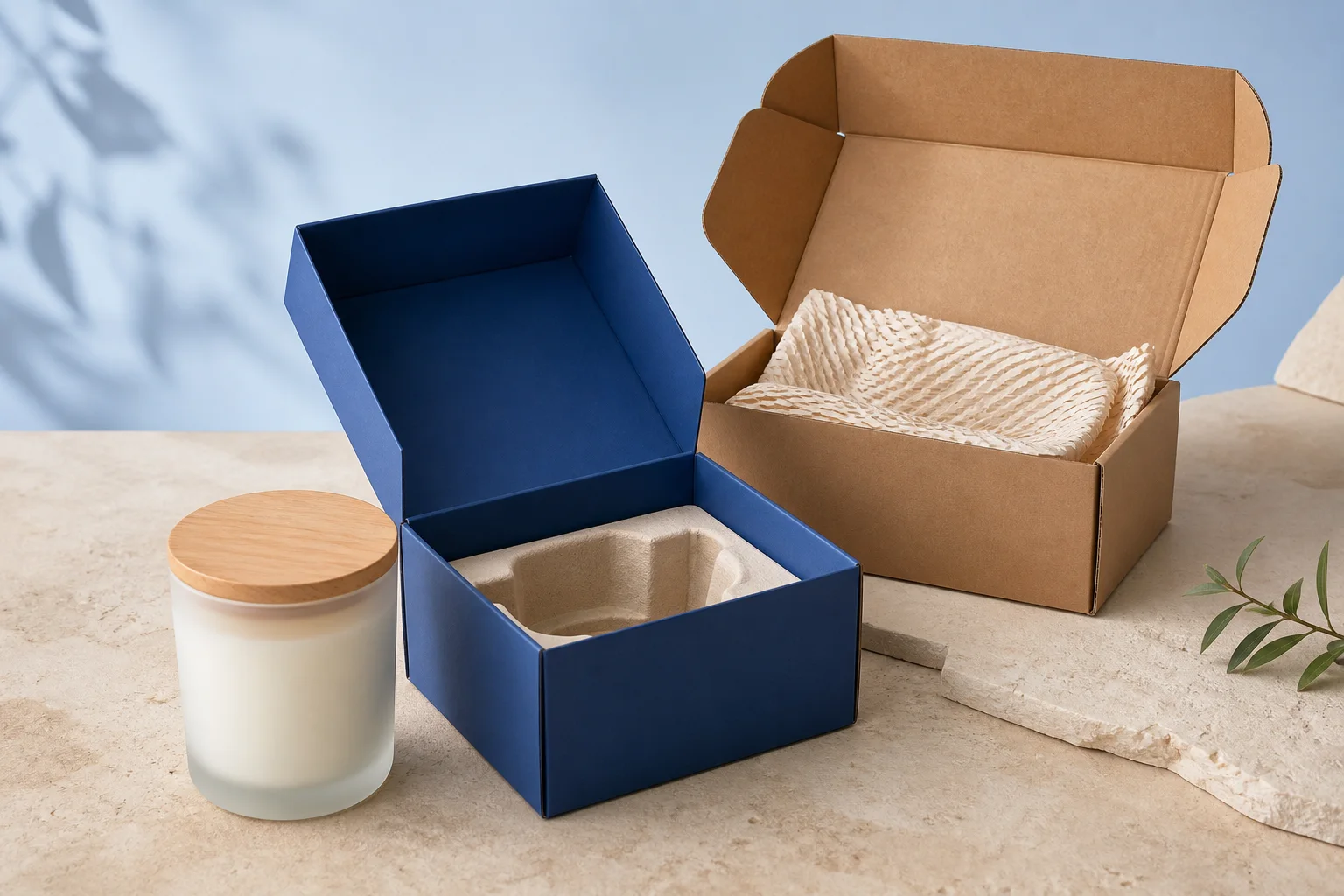
Custom candle boxes have to do more than look premium. A glass jar is heavy for its size, the lid may lift or mark, and the presentation box may still need a separate transport package. The right solution connects product fit, retail presentation and distribution protection instead of asking one decorative box to perform every job.
Reddit candle sellers repeatedly ask how to reduce glass breakage, keep jars from moving, prepare individual boxes for wholesale and avoid excessive wrapping. One seller reported breakage even after using many layers of protective material; another described retail boxes that presented the candle but offered limited shipping protection. A wholesale-focused post asked how to add individual packaging without making several low-volume box sizes uneconomical. These are qualitative buyer experiences, not controlled tests, but they reveal useful design questions. [1] [2] [3]
1. Think in three candle packaging layers
Product
Glass or metal vessel, wax, lid, label and any dust cover. Its dimensions, weight and tolerances define the pack.
Retail presentation
Folding carton, rigid box, sleeve or mailer plus the candle box insert that holds the product.
Distribution
Parcel shipper, cushioning, wholesale divider carton or pallet system selected for the actual route.
A luxury candle packaging box can be excellent on a shelf and still be unsuitable as a parcel shipper. Conversely, a strong corrugated candle shipping box may protect the jar but fail to deliver the premium retail experience a brand wants. Separating the layers makes the trade-offs visible.
Decide whether the customer will see the transport carton, whether the retail box needs to arrive display-ready and whether several candles will travel together. Those decisions change materials, printing, inserts and carton count.
2. Match candle packaging boxes to the sales route
| Sales route | Typical packaging need | Questions to settle |
|---|---|---|
| Retail shelf | Printed folding carton or premium rigid box | Display, tamper needs, labeling area and case packing |
| Direct to consumer | Retail box or branded mailer inside a qualified shipper | Drop, vibration, compression, moisture and unboxing |
| Subscription or gift set | Multi-product insert inside a presentation mailer or rigid box | Mixed weights, product separation and pack-out sequence |
| Wholesale case | Individual retail boxes or wrapped jars with dividers in a master carton | Units per case, stacking, jar-to-jar contact and retailer handling |
Do not assume the same pack can move safely through every route. A case delivered on a controlled pallet has different exposures from a single parcel moving through a carrier network. If retail partners break cases and reship units, design for that additional handling instead of testing only the inbound wholesale case.
3. Measure the real jar, lid and packed weight
Send the packaging supplier production-intent samples whenever possible. Nominal vessel capacity does not define the package. Measure maximum outside diameter or width, total height with the lid installed and finished packed weight. Record variation across several jars and lids rather than relying on one ideal sample.
- Jar geometry: identify shoulders, tapers, feet, seams or protrusions that affect support.
- Lid behavior: check whether the lid can lift, rotate, scratch or transfer pressure to the vessel.
- Surface sensitivity: note labels, coatings, frosted finishes and decoration that can rub against an insert.
- Center of mass: a heavy glass base needs support that prevents tipping and repeated impact.
- Temperature exposure: discuss seasonal routes if appearance or product behavior is temperature-sensitive; structural cushioning alone is not thermal qualification.
There is no universal clearance for glass jar candle packaging. Too loose allows movement; too tight can make loading difficult or concentrate force on fragile features. The correct tolerance comes from product variation, material recovery, assembly method and performance testing.
4. Choose the custom candle box structure by job
Folding cartons for lightweight retail presentation
Paperboard folding cartons ship flat, provide printable surfaces and can work for lower-weight candles or jars already controlled by an inner tray. They normally need a protective outer carton for parcel delivery. Window openings reduce printable and structural area, so sample the complete design.
Rigid boxes for luxury candle packaging
A lid-and-base rigid box or shoulder-style box creates a premium reveal and supports high-value gifting. Rigid construction adds material and incoming freight volume. It should not be treated as a parcel shipper unless the complete packed system has been qualified for that route.
Corrugated mailers for ecommerce
A custom corrugated mailer can combine brand presentation with better transport strength. It still needs an insert or cushioning plan that keeps the jar stable and away from the walls. The flute, board grade and closure should be selected around the candle weight and distribution risk.
5. Compare candle box inserts by performance
| Insert | Useful characteristics | Confirm before ordering |
|---|---|---|
| Molded fiber | Contoured support, paper-based appearance, repeatable location | Tooling, surface contact, dust, fit tolerance and removal |
| Corrugated insert | Ships flat, strong directional support, easy integration with mailers | Flute direction, cut edges, locking tabs and assembly time |
| Paperboard cradle | Clean printed presentation for lighter jars | Board stiffness, fold sequence and support beneath the base |
| Foam or EVA | Precise fit and cushioning for fragile, higher-value products | Density, odor, surface marking, disposal goals and tooling |
The insert should control the base and body without pressing on a delicate lid, label edge or decorative wax surface. Provide finger access or a pull feature so the customer can remove the candle safely. Test how the material behaves after storage and repeated handling, not only immediately after assembly.
For a gift set, distribute product weight across the insert and separate glass components. A visually balanced layout can still fail if the heaviest jar flexes the tray or collides with a lighter accessory. Review available insert, paper and finish options only after the protective job is clear.
6. Use dividers deliberately for wholesale candle boxes
Wholesale cartons often group several jars in one master case. Corrugated partitions can reduce jar-to-jar contact and organize loading, but the divider grid is only one part of the system. The top, bottom, side walls, empty cells and case closure also need protection.
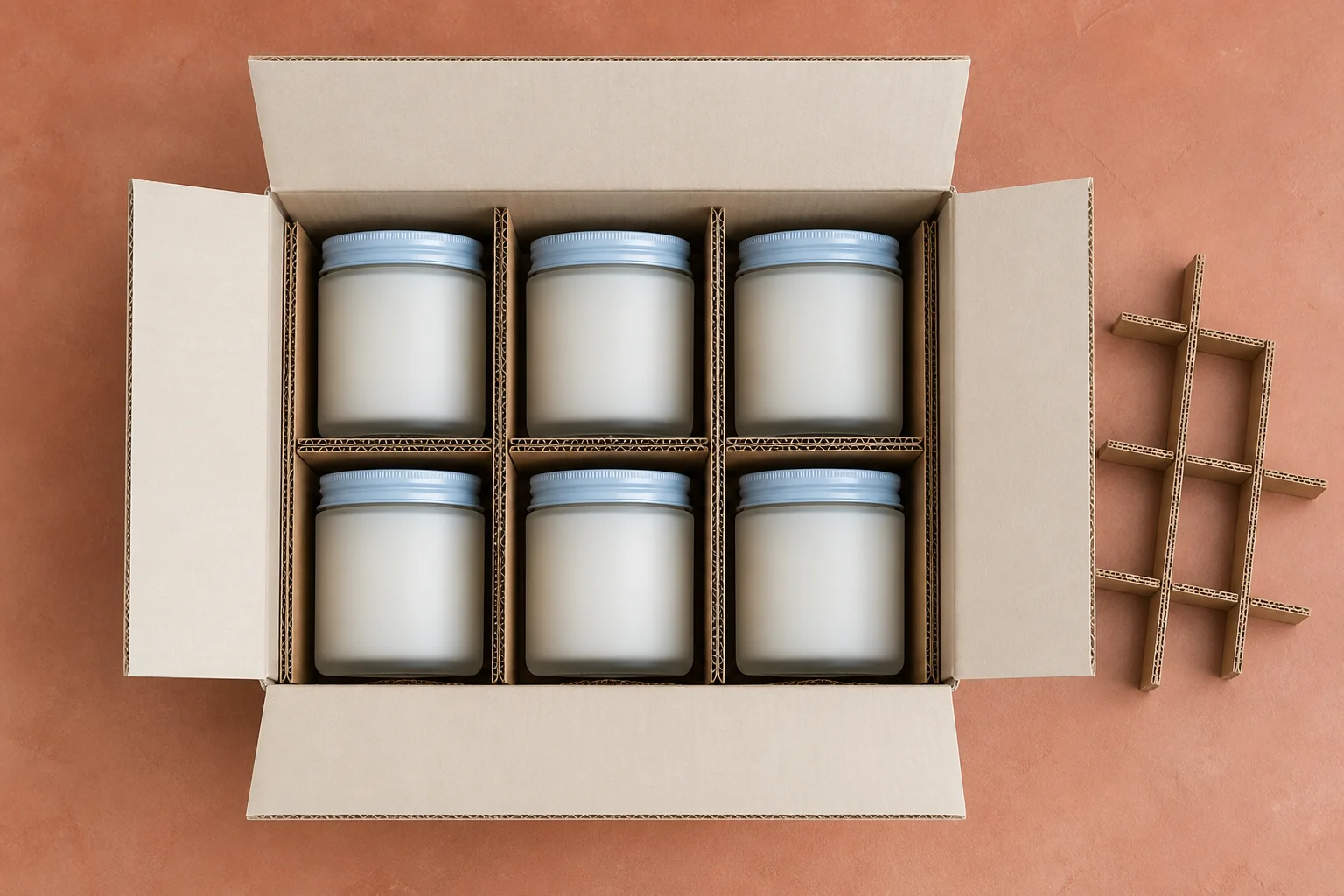
Do not copy a six-unit or twelve-unit case simply because it is common in another business. Compare safe gross weight, manual handling, retailer order quantity, pallet efficiency and the consequences of one empty position. If individual retail boxes sit inside the case, test the entire nested system.
Reddit discussions also show the operational side: sellers need packaging that is protective without being excessively slow or costly to assemble. Time the pack-out. A structure that requires several wraps, multiple tape steps and repeated adjustments may justify a fitted insert even when its unit price is higher.
7. Test the complete candle pack for its route
A gentle shake check can reveal obvious movement, but it is not a transit qualification. Define damage before testing: cracked glass, loosened lid, scuffed label, dented retail box, displaced wax or leakage may have different acceptance limits.
Use bench trials to compare early concepts consistently, then select a route-appropriate laboratory procedure when the risk and volume warrant it. ISTA describes 1-Series tests as screening tools and 3-Series procedures as general simulations of transport hazards. ISTA 3A applies to individual packaged products moving through parcel delivery systems; the right procedure depends on the actual package and route. [4]
Production-intent products and materials matter. A test on a generic empty jar does not prove the packed candle, decorated surface, insert, retail box and shipper will perform together. Keep a record of sample versions, pack-out steps and post-test inspection results.
8. Give the candle packaging manufacturer a quote-ready brief
Include these details
- Jar maximum diameter or width, height with lid and packed weight
- Photos plus physical production-intent samples
- Single candle, gift set and wholesale case combinations
- Retail, ecommerce, wholesale or mixed distribution route
- Preferred box style, insert material and opening experience
- Artwork, print colors, finishes and required labeling area
- Initial quantity, SKU count and likely reorder volume
- Destination, target date and testing requirement
Ask the supplier to label dimensions as internal or external and separate the retail box, insert, shipper, tooling, sample and delivery costs. If multiple candle sizes are planned, request a shared-platform option and a dedicated-fit option so the trade-off is visible.
Do not approve appearance alone. Use the custom packaging sample approval checklist to record product fit, insert retention, print, finish, assembly and the intended production method. For quantity planning, review the custom packaging MOQ guide.
Candle packaging FAQs
Can a retail candle box ship without an outer carton?
Do not assume it can. Many paperboard and rigid retail boxes are designed for presentation, not parcel hazards. Use an outer shipper unless the complete retail pack has been designed and qualified for direct shipping.
What is the best insert for a glass jar candle?
There is no single best material. Molded fiber, corrugated, paperboard and foam can all work when their geometry, stiffness and cushioning match the jar, surface, weight and route.
How much space should be left around a candle jar?
There is no universal clearance. Allow for vessel and insert tolerances while preventing uncontrolled movement and hard contact. Confirm the result with production-intent samples and performance testing.
Do fragile labels prevent candle damage?
A label is not a substitute for protective packaging. Design the pack for expected handling and follow the carrier's current requirements.
Can one custom candle box fit several jar sizes?
Sometimes a shared outer box can use different inserts, but only when each configuration maintains protection, presentation and assembly efficiency. Compare that approach with dedicated sizes.
Sources & editorial notes
Reddit threads were used to identify recurring buyer questions, not to establish universal packaging rules or damage rates. This is a qualitative editorial guide. Technical test selection should be made for the actual product and distribution route.
Quote-ready candle packaging
Show us the jar, route and unboxing goal.
Share the candle dimensions, packed weight, quantities, sales route and reference style. Triya Gift can discuss retail box, insert and shipping-carton options as one packaging system.
Request custom candle box optionsChoose a structure or ask for a recommendation
Compare suitable styles, then share your product, estimated quantity and delivery country. Dimensions and artwork can follow.