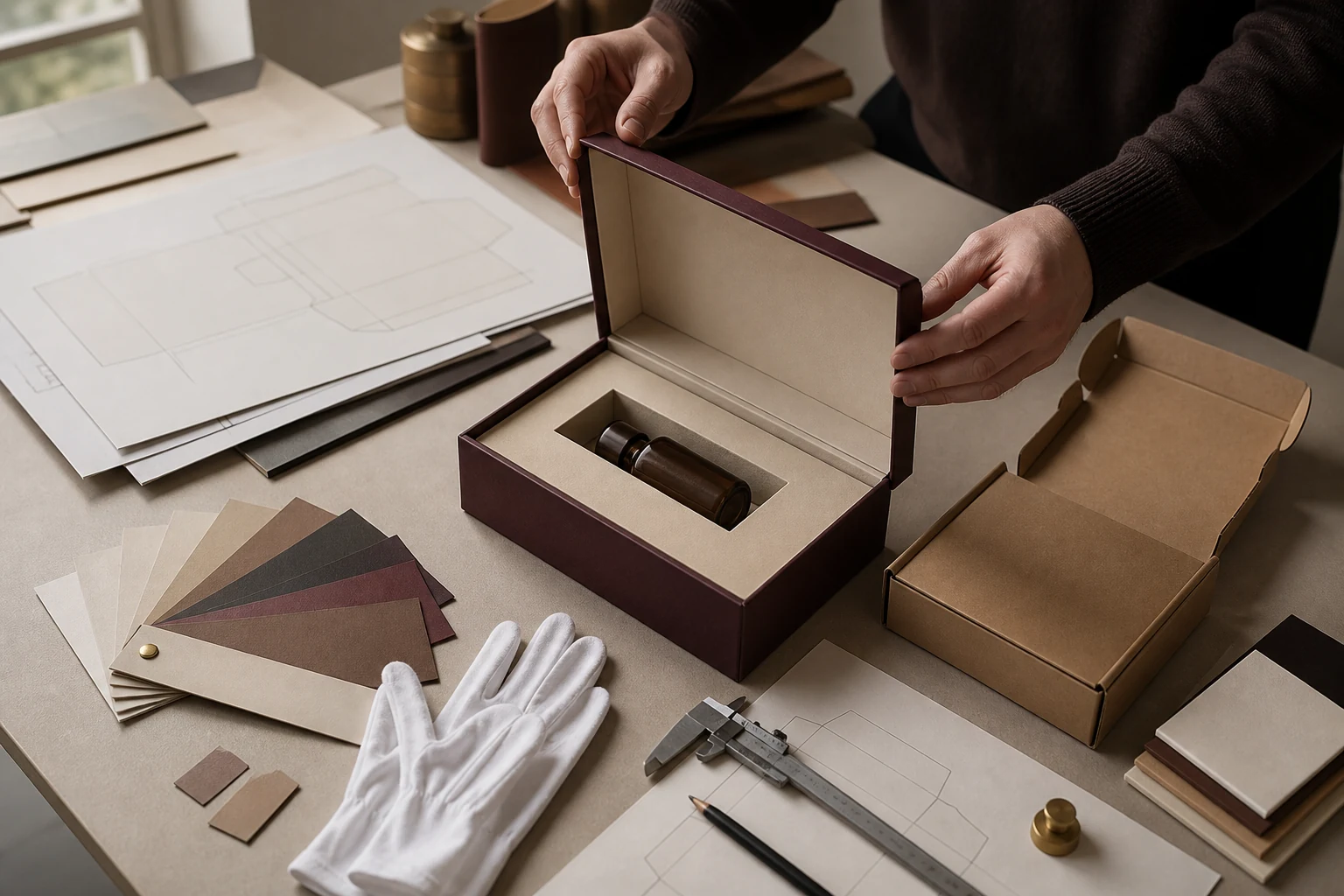
“What is your MOQ?” sounds simple, but the answer changes with the box, material, artwork and process. A meaningful minimum belongs to a defined specification. Change the size, print method or insert and the production setup may change too.
Triya Gift order minimums: 500 pieces for boxes other than calendar boxes; 1,000 pieces for calendar boxes.
Eight factors that set a custom packaging MOQ
| Factor | How it affects the minimum |
|---|---|
| 1. Structure | Corrugated mailers, folding cartons and handmade rigid boxes use different workflows. |
| 2. Material | Board, paper and specialty substrates may be purchased in standard sheets, rolls or batches. |
| 3. Box size | Size affects sheet yield, cutting layout, machine compatibility and waste. |
| 4. Print process | Digital, offset, flexographic and screen printing have different setup economics. |
| 5. Artwork versions | Each colorway, language, size or SKU may require its own plates and changeover. |
| 6. Finishes | Foil, embossing, spot UV and lamination can add dies and separate passes. |
| 7. Insert | Paper trays, molded pulp, foam and fabric inserts use different tooling and conversion. |
| 8. Assembly | Handmade rigid boxes require labor planning; fold-flat formats may use more automation. |
Why minimums differ by packaging structure
Automated printing and converting is planned around machine setup and material yield. Handmade rigid packaging adds wrapping, forming, alignment and inspection. An insert can have a different minimum from the outer box, especially when it needs a mold or specialty material.
The lowest possible minimum is not always the best decision. A very small run may carry disproportionate setup cost. A larger run may lower unit cost but raise inventory risk. The useful quantity fits both production reality and the sales plan.
Can several SKUs be combined to reach one MOQ?
Sometimes. Combining designs is most practical when size, structure, board, paper and finish remain the same. Different artwork can still require separate setup, so a supplier may set a minimum per design even when the physical box is shared.
Do not assume ten designs of one hundred pieces equal one design of one thousand. Each artwork version adds file checks, make-ready, color control, sorting and packing.
Variables that are easiest to standardize
- Outer dimensions
- Board and wrap paper
- Insert construction
- Base print colors
- Finish position
- Carton packing
How to plan a lower-risk first order
Start with demand, not the maximum discount tier. Estimate sell-through by SKU and include sampling, production and transit time before a reorder can arrive. Confirm storage space for assembled or flat-packed packaging.
- Launch essential SKUs first instead of splitting volume across many versions.
- Keep the first structure and finish focused.
- Approve a physical sample and record what is production-equivalent.
- Agree on overrun and underrun tolerance.
- Ask for quantity breaks around realistic demand.
- Plan the reorder point using production and transit lead time.
Use the related custom packaging cost guide to separate setup, unit, packing and delivery costs.
Questions to ask before accepting an MOQ
Ask the supplier to confirm
- MOQ per size and artwork
- Finish-specific minimums
- Quantity breaks
- Tooling and setup
- Material substitutions
- Production tolerance
- Sample type
- Reorder lead time
The answer should connect the minimum to the production method. If you need a lower run, ask which change would make it practical: common size, simpler finish, different print method, stock insert material or fewer artwork versions.
Custom packaging MOQ FAQs
What does MOQ mean in custom packaging?
It is the smallest production run for a defined structure, material, print and finish specification.
Why do packaging minimums vary?
Printing, material conversion, tooling, finishing and assembly have different setup requirements.
Can several designs be combined to reach one MOQ?
Sometimes, when size, structure and materials are shared. Artwork, colors, finishes or inserts may still require separate setups.
How can a buyer lower first-order risk?
Use realistic demand, limit essential SKUs, simplify finishes, approve a sample and plan storage and reorder timing.
Check the minimum for your specification
Send structure, size, artwork versions, finish, insert, quantity and destination. Ask which variables control the minimum.
Check MOQ and sample optionsWhen dates matter, use our custom packaging milestone planner to clarify which approvals and transit stages sit outside quoted production time.