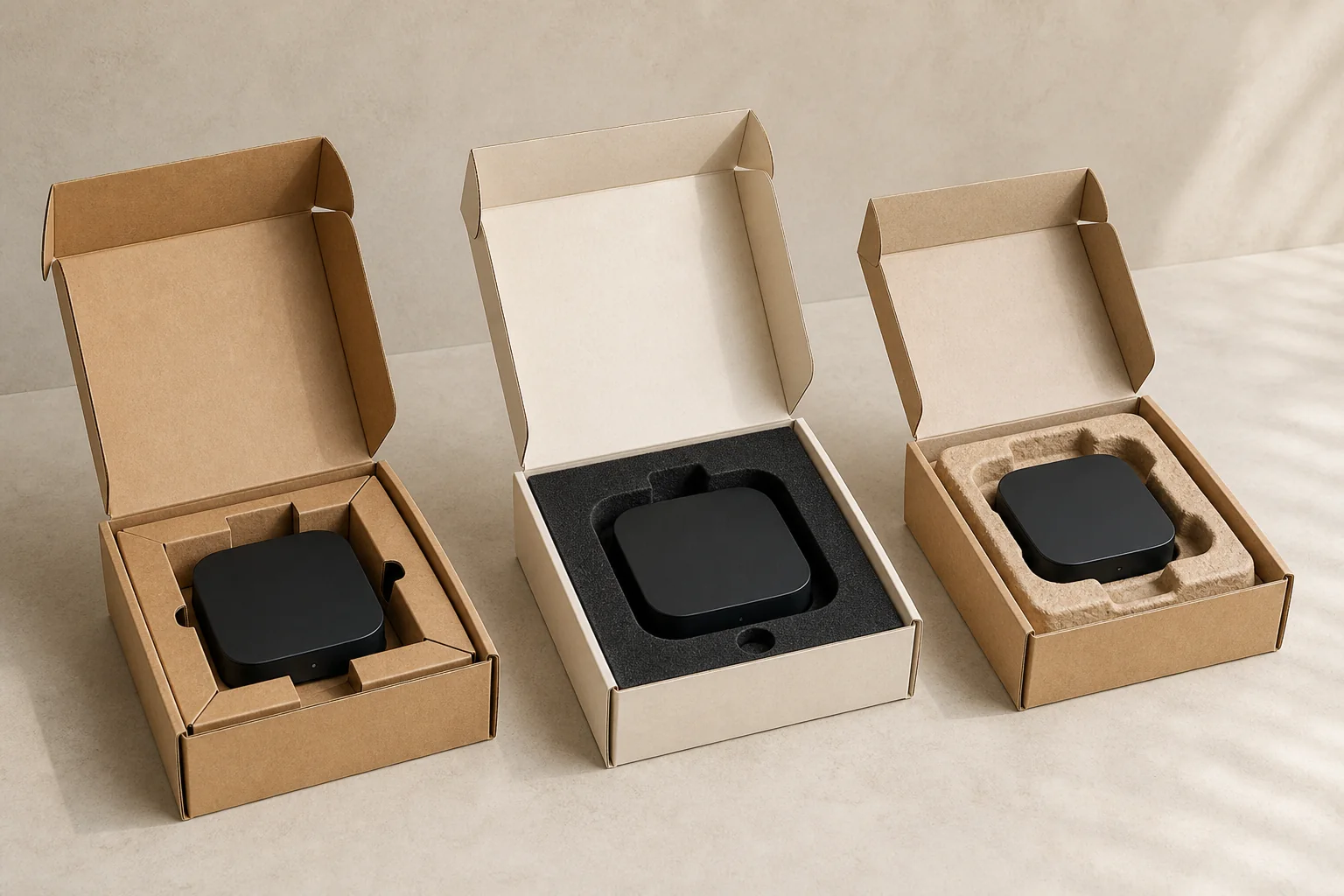
Custom box inserts turn an outer box into a product-specific packaging system. They locate the item, separate accessories, manage movement, protect sensitive surfaces and shape the unboxing sequence. But a clean sample can still fail if the insert is too brittle, too loose, difficult to assemble or designed for a retail shelf when the package will travel through a parcel network.
Recent Reddit discussions make the buying problem unusually clear. A low-volume device maker wanted professional protection without committing to thousands of foam inserts while the product was still evolving. Small-business owners asked where to source unique multi-item trays in quantities below 100. Another buyer with a fragile product was unsure whether cardboard, soft foam or molded material justified its cost and whether formal transit testing was necessary. Electronics sellers also described bubble wrap as slow and visually weak, but felt overwhelmed by the alternatives. [1] [2] [3] [4]
1. Define the protection job before choosing a material
An insert can perform four different jobs, and many projects need more than one. First, location prevents the product from sliding or rotating. Second, separation keeps accessories and hard surfaces from colliding. Third, cushioning manages shock by allowing controlled deformation or movement. Fourth, presentation controls what the customer sees and how each part is removed.
Hold the product
Support strong zones and prevent uncontrolled movement without loading delicate buttons, lids or edges.
Manage hazards
Match stiffness and cushioning to weight, fragility, drop exposure, vibration and stacking.
Guide the reveal
Organize components, provide finger access and keep assembly practical for the packing team.
Start with the actual production-intent product, not a catalog dimension. Record maximum length, width and height across several units, packed weight, center of mass, protrusions, surface finish and the areas that may safely carry load. A molded component, coated bottle or electronic housing may have different tolerance and abrasion limits even when the outside dimensions are similar.
2. Compare custom packaging insert materials
| Insert type | Strong fit | Trade-offs to confirm | Typical buying trigger |
|---|---|---|---|
| Corrugated | Heavier products, mailers, multi-part supports, flat shipping | Visible cut edges, flute direction, fold complexity, surface contact | Protection plus efficient storage and assembly |
| Paperboard | Light products, cosmetics, cards, accessories, printed presentation | Lower cushioning, stiffness, tab retention, weight limit | Clean retail reveal with minimal depth |
| Foam or EVA | Fragile, valuable or surface-sensitive products needing a precise cavity | Density, recovery, odor, dust, disposal route, incoming volume | High perceived value and controlled cushioning |
| Molded pulp | Repeatable contoured support and paper-fiber presentation | Tooling, minimums, draft angles, surface texture, moisture response | Higher-volume molded fit with fiber-based positioning |
Unit price alone is a weak comparison. Include tooling, incoming freight, storage, assembly time, damage risk and end-of-life communication. A flat corrugated insert may cost more labor to fold; a foam insert may arrive ready to load but consume more storage volume. Compare the cost of a complete packed order, not only the insert line on a quotation.
3. When cardboard box inserts work best
Die-cut corrugated inserts use folds, slots, bridges and locking tabs to suspend or block a product. They can support substantial weight when flute direction and load paths are intentional. Paperboard cradles use a thinner printable sheet and suit lighter products or presentation layers inside rigid boxes.
Cardboard inserts are especially useful when several parts need defined compartments, when the design should ship flat or when a brand wants a mostly fiber-based pack. The engineering challenge is not merely cutting an outline. The insert must remain locked during packing and transit, avoid sharp contact with sensitive finishes, resist collapse under the product and allow the customer to remove every component.
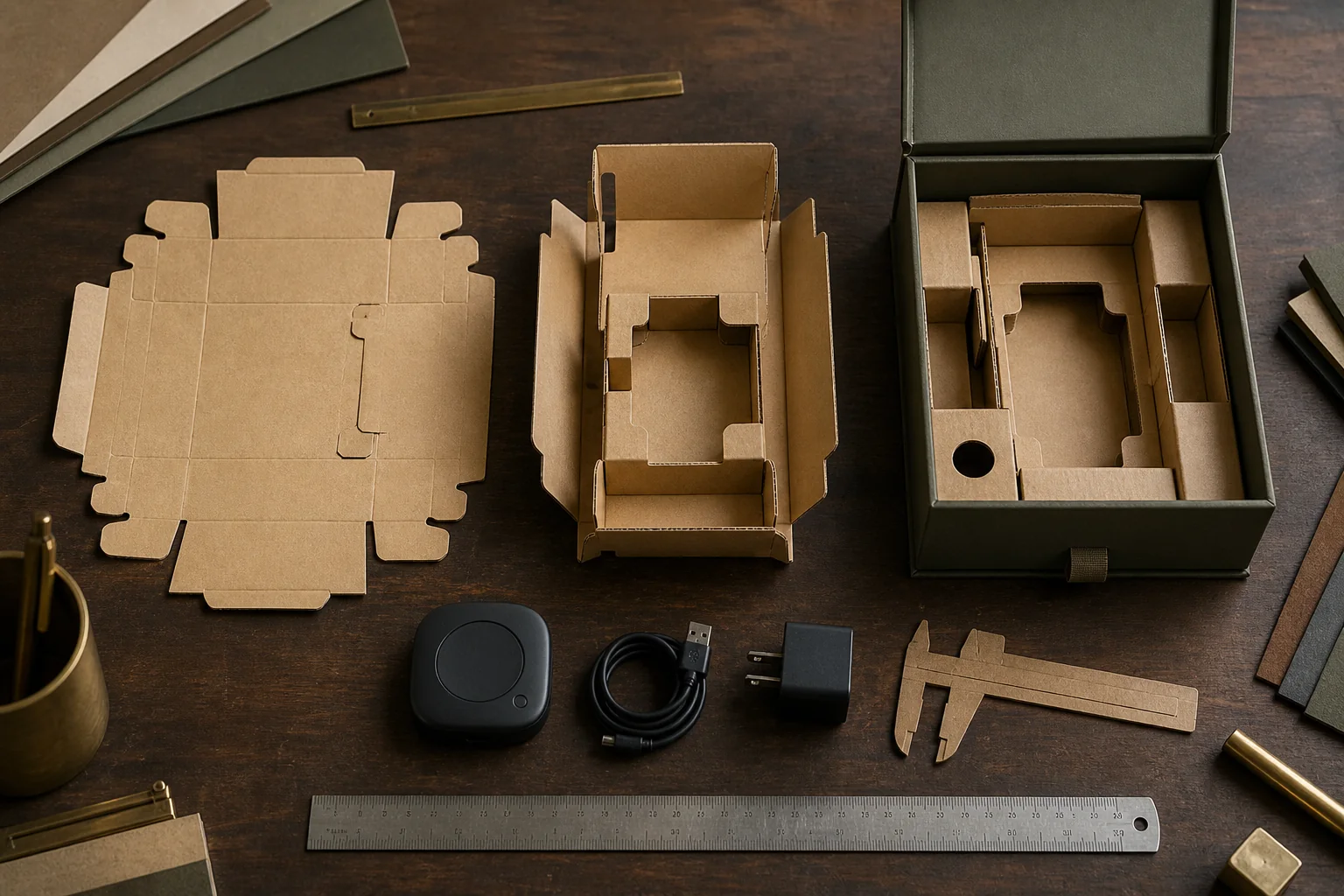
Ask whether the insert is supplied flat or preassembled. Time the full sequence: fold, lock, load, add accessories, close and inspect. A clever structure is not efficient if operators need to study it on every order. For more structure options, review Triya Gift's custom materials and insert choices.
4. When foam packaging inserts earn their place
Foam can create a precise cavity, protect delicate finishes and provide controlled cushioning when the type, density and geometry match the product. Dark foam also produces a strong premium contrast for electronics, tools, jewelry and presentation kits. These benefits explain why buyers often request it first.
The word “foam” is not a specification. Clarify material family, density, thickness, compression behavior, lamination, color, odor, dust and surface compatibility. A cavity that grips too tightly may make removal difficult or load a weak feature; a loose cavity can allow repeated impacts. Finger notches, pull ribbons and accessory channels should be designed at the same time as the main pocket.
Foam may be a sensible protective choice, but do not make broad sustainability claims without knowing the material and local recovery route. If a paper-based appearance is important, compare protection using corrugated or molded pulp rather than choosing by marketing language alone.
5. When molded pulp inserts make sense
Molded pulp forms a contoured fiber tray around product support zones. It can communicate a natural paper texture, locate multiple items and provide repeatable geometry. It is often considered for electronics, personal care, home products and gift sets where brands want an alternative to a dark foam presentation.
Tooling and production quantity matter more than with a simple die-cut insert. Draft angles, radii, wall transitions and nesting affect how the part forms, releases, dries and ships. The surface is normally more textured than coated paperboard or foam, so inspect contact with decorated or high-gloss products. Moisture exposure and dimensional tolerance also belong in the sample plan.
“Paper-based” does not remove the need to minimize material. The U.S. EPA places source reduction and reuse above recycling in its waste-management hierarchy. That supports a practical sequence: remove unnecessary material, use enough protection to prevent product loss, and then consider recovery and material communication. [6]
6. Prototype fit before committing to tooling or volume
Low-volume Reddit buyers often worry that a product will change before they use a large insert order. Treat that as a version-control problem. Freeze the product revision used for the sample, label every prototype and record the exact outer box, insert material and pack-out steps. If dimensions are still moving, compare a lower-tooling folded insert with the final high-volume molded solution.
A practical prototype sequence
- Share product drawings, photos, packed weight and physical samples.
- Map safe support zones, fragile features and accessory positions.
- Build a white structural sample before approving print or finish.
- Load several production-intent products to check tolerance variation.
- Time assembly and let someone unfamiliar with the pack follow the steps.
- Run consistent screening tests, revise one variable at a time and document results.
- Approve a production-intent sample and define what requires retesting.
Do not force one insert to fit several SKUs unless every configuration remains stable. A shared outer box with SKU-specific paperboard trays can be efficient; universal empty space filled by extra wrap often is not. Compare inventory simplicity with protection and packing time.
7. Test the complete product-and-package system
A shake test can reveal obvious looseness, and controlled bench drops can compare early versions. Neither proves performance through a full distribution route. Define failure before testing: cosmetic scuff, displaced accessory, cracked housing, non-functioning electronics, dented presentation box and opened closure may have different acceptance limits.
ISTA describes 1-Series procedures as screening tests and 3-Series procedures as general simulations of transport hazards. Its guidance lists 3A for packaged products up to 150 lb moving through North American parcel delivery, while other routes use different procedures. Select a method for the actual distribution system and product risk rather than copying a test from another brand. [5]
Use production-intent materials and repeat testing when a change could affect performance—product dimensions, insert geometry, board grade, foam density, closure method or outer carton. Monitor real shipments after launch because laboratory work and field performance answer different questions.
8. Give the manufacturer a quote-ready insert brief
Include these details
- Maximum product dimensions, weight and tolerance
- Physical samples and photos of sensitive surfaces
- All accessories, cables, manuals and spare parts
- Retail, parcel, wholesale or mixed distribution route
- Outer box style and internal dimensions
- Target material or performance priorities
- Required opening order and finger access
- Initial quantity, SKU count and reorder forecast
- Assembly method and pack-out time target
- Testing standard and damage criteria
Ask suppliers to separate structural sample, print sample, tooling, unit, assembly and delivery costs. If you are undecided, request two concepts built around the same product and route—for example, a flat corrugated insert and a ready-to-load foam or molded tray. Then compare the complete operational result.
Use the custom packaging sample approval checklist to record fit and production details, and the custom packaging cost guide to compare quotations beyond unit price.
Custom box insert FAQs
What is the best material for custom box inserts?
There is no universal best. Corrugated suits flat shipping and structural support, paperboard suits lighter presentation, foam offers precise cushioning, and molded pulp provides contoured fiber support. Choose using the product, route, packing process and verified test results.
Can cardboard inserts protect fragile products?
Yes, when the geometry, board, flute direction and support zones are engineered for the product and outer box. Fragility and route determine whether additional cushioning or another material is needed.
Are foam inserts always more protective?
No. Performance depends on foam type, density, thickness, cavity fit and the complete package. Foam that is too firm, too soft or poorly fitted can underperform.
Can one insert hold several product sizes?
Sometimes, but each configuration must prevent harmful movement and remain easy to pack. Separate trays inside a shared outer box may be more reliable than one loose universal cavity.
Do I need to send the product to the packaging manufacturer?
Accurate drawings help, but production-intent samples allow the supplier to check real tolerances, surfaces, loading and removal. For fragile or unusual products, physical samples are strongly recommended.
Discussion and technical sources
Reddit posts are qualitative buyer experiences, not controlled performance evidence. They are used here to identify recurring procurement questions.
- Reddit: 3D printed packaging inserts for shipping — low-volume fit, design change and transit concerns.
- Reddit: Where can I get custom cardboard boxes and inserts made? — sourcing unique inserts and small runs.
- Reddit: Void packing options and ISTA testing — material selection and validation questions.
- Reddit: Packaging for electronics and crafts — protection, pack-out speed and presentation.
- International Safe Transit Association: Test Procedures and Getting Started with Design & Testing.
- U.S. EPA: Sustainable Materials Management hierarchy.
Quote-ready insert development
Show us the product, components and route.
Share dimensions, packed weight, photos, quantities and your opening goal. Triya Gift can discuss corrugated, paperboard, foam and molded-pulp insert concepts as part of the complete custom box.
Request custom box insert options