Shipping damage is rarely caused by one dramatic event. Packages experience vibration, repeated handling, stacking pressure, drops, abrasion and changes in humidity throughout the route. Generic boxes often add uncontrolled void space, allowing the product to build momentum before striking a wall or another component.
1. Measure the baseline before promising a reduction
The original goal of cutting damage by 80% can be useful as an internal improvement target, but it is not a universal packaging guarantee. A credible percentage needs a starting damage rate, consistent definition of “damage,” order volume, route, time period and comparison method.
Collect photographs and codes from returns. Separate cracked products, cosmetic scuffs, crushed corners, leaks, detached accessories and presentation damage. Each failure points to a different design change. A stronger outer box will not solve a loose bottle rubbing against an insert.
2. Identify the hazards on the real route
Vibration and impact
Void space lets products accelerate, collide and abrade during trucks, conveyors and manual handling.
Compression and stacking
Outer cartons and inner structures must resist the loads created in storage, freight and last-mile networks.
Moisture and temperature
Humidity can weaken paper-based materials, while temperature changes may affect products, adhesives and finishes.
Map the complete route: factory packing, master-carton palletization, international freight, warehouse picking, parcel carrier and customer opening. Protective packaging should be designed for the most demanding expected stage, with an agreed safety margin.
3. Engineer fit, separation and removal together
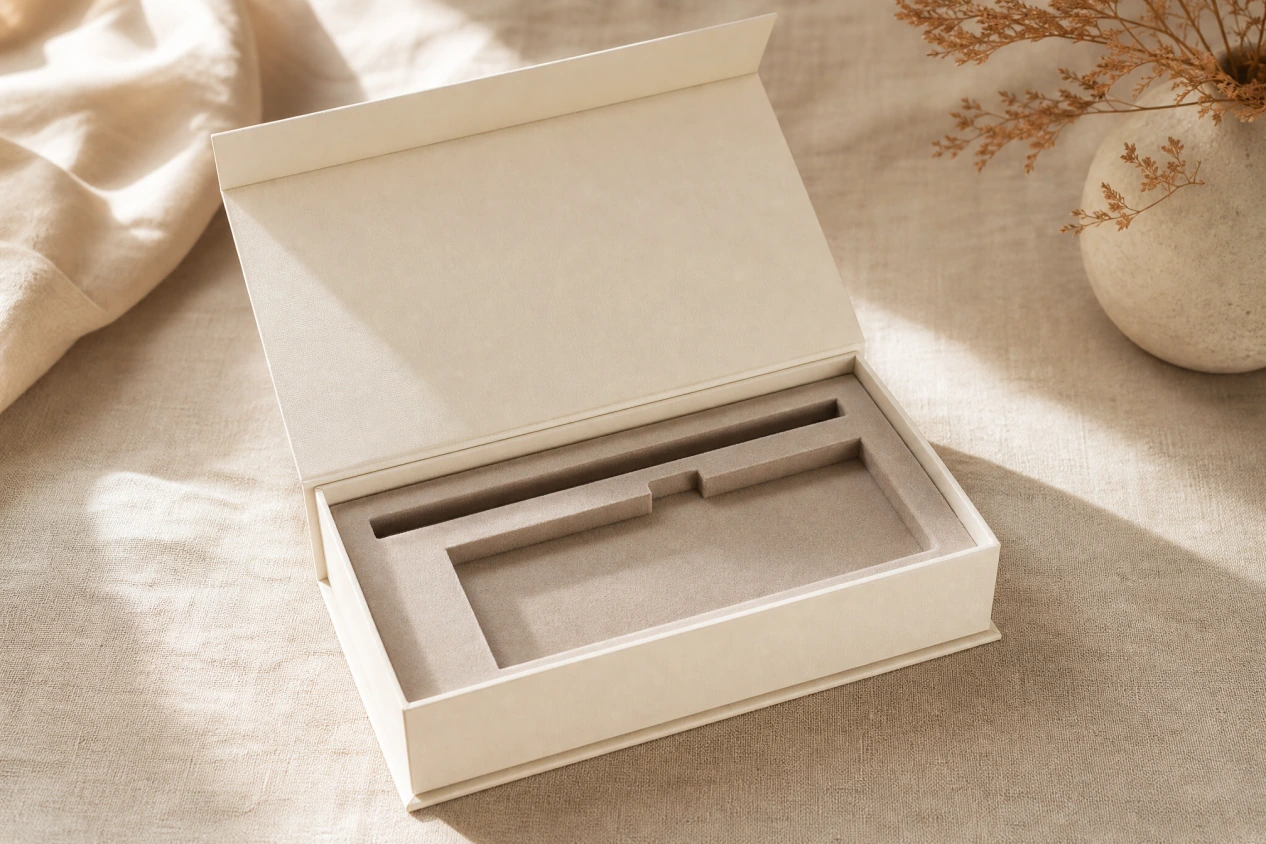
A custom insert should prevent the product from moving while keeping it away from the outer walls. Strategic clearance gives the material space to deform and absorb energy. Multiple items need dividers so they cannot strike one another. Heavy components should not sit above fragile ones when the pack can change orientation.
Foam can provide precise retention for heavy or sensitive products. Molded pulp offers cushioning with a paper-based appearance. Folded corrugated or paperboard structures can work well for regular shapes and efficient tooling. Material choice should follow product weight, fragility, surface sensitivity and recovery goals.

4. Select board strength for the packed system
A premium rigid box provides shape and presentation, but it is not automatically a parcel shipper. Corrugated outer cartons add puncture, stacking and handling resistance. The corrugated grade, flute, edge-crush or burst requirement and closure method should be chosen around the packed weight, dimensions, pallet pattern and delivery route.
Protection should work in three dimensions. Add support above the product where vertical compression is a risk, reinforce vulnerable corners, and prevent the insert from shifting inside the outer box. Avoid simply filling every gap with loose material; controlled geometry is easier to repeat in production.

5. Validate the complete pack, then run a pilot
- Approve fit and workmanshipUse real production samples or accurate dummies to check retention, removal, closure and assembly.
- Define the test planChoose drop, vibration, compression and environmental checks that reflect the product and distribution route.
- Test the final configurationInclude the product, inner box, insert, outer carton, void fill, tape and packed orientation.
- Inspect and diagnoseRecord product, insert and carton condition after each sequence; revise the failure point rather than adding material blindly.
- Pilot the production packShip a controlled batch through the real route and compare claims with the baseline before scaling.
Keep approved samples, drawings, packing instructions and photographs with the order. A good prototype can still fail if production uses a looser insert, different carton or inconsistent packing method.
6. Calculate the business case beyond box price
Compare the added packaging cost with product replacement, outbound and reship freight, return handling, customer service, lost margin and review impact. A slightly more expensive insert may be economical when it prevents a high-value item from moving. Conversely, heavier packaging is not automatically better if it increases freight without reducing the measured failure.
Damage-reduction brief
- Current damage rate and definition
- Failure photographs and return codes
- Product size, weight and weak points
- Surface and cosmetic sensitivity
- Full distribution route
- Current box and insert specification
- Outer-carton packing method
- Target test and acceptance criteria
- Pilot quantity and measurement period
- Production packing instructions
For size optimization across multiple products, also read our right-size packaging guide.
Frequently asked questions
Can a rigid box prevent shipping damage by itself?
It can support and present the product, but parcel protection usually requires a fitted insert and a correctly specified corrugated outer carton.
Which insert material protects best?
There is no universal winner. Foam, molded pulp and folded paper structures behave differently; select and test them against product weight, fragility, surface sensitivity and route.
How can an 80% damage reduction be verified?
Define the baseline and claim criteria, use comparable order volumes and routes, introduce the validated pack, then compare confirmed damage over a meaningful period.
Protective packaging review
Design against the failure you actually see.
Share product samples, dimensions, packed weight, route and damage photographs. Triya Gift can review structure, insert and outer-carton options for sampling and testing.
Request a protection review