THE BUYER'S COST WORKSHEET
Ships flat.
But does it cost less?
Flat-pack vs assembled gift boxes: compare the cost of a usable box, not just the factory price.
By Triya Gift Packaging Team · Updated
The direct answer
A flat-pack gift box costs less overall only when its freight and storage savings exceed any extra box price, erection labor, consumables and rework. Compare both formats at the same packing site, quantity and finished specification. Use actual master-carton dimensions and a timed assembly trial. Shipping empty boxes flat does not automatically reduce the parcel cost once the product is packed.
A buyer in a Reddit packaging discussion questioned the price of collapsible rigid boxes. The useful issue is not whether one quoted price is normal; it is whether the space saving pays for the extra construction and work. A separate buyer discussion about branded packaging raises the related worry of volumetric shipping cost. These are qualitative buyer questions, not verified price benchmarks.
Scope: empty custom paper gift boxes supplied to a brand or packing facility, then filled with products. This worksheet compares logistics formats, not tax treatment or protective performance. Product fit and route-appropriate protection must pass before cost decides. Product visuals illustrate configurations, not measured packing capacities.
A magnetic closure does not tell you how a box ships.
Collapsible rigid gift box means a wrapped rigid-board construction designed to arrive flattened and be erected at the receiving site. Assembled rigid box arrives with its three-dimensional body already formed. A folding carton is a different paperboard construction; it should not silently replace the rigid format in your comparison.
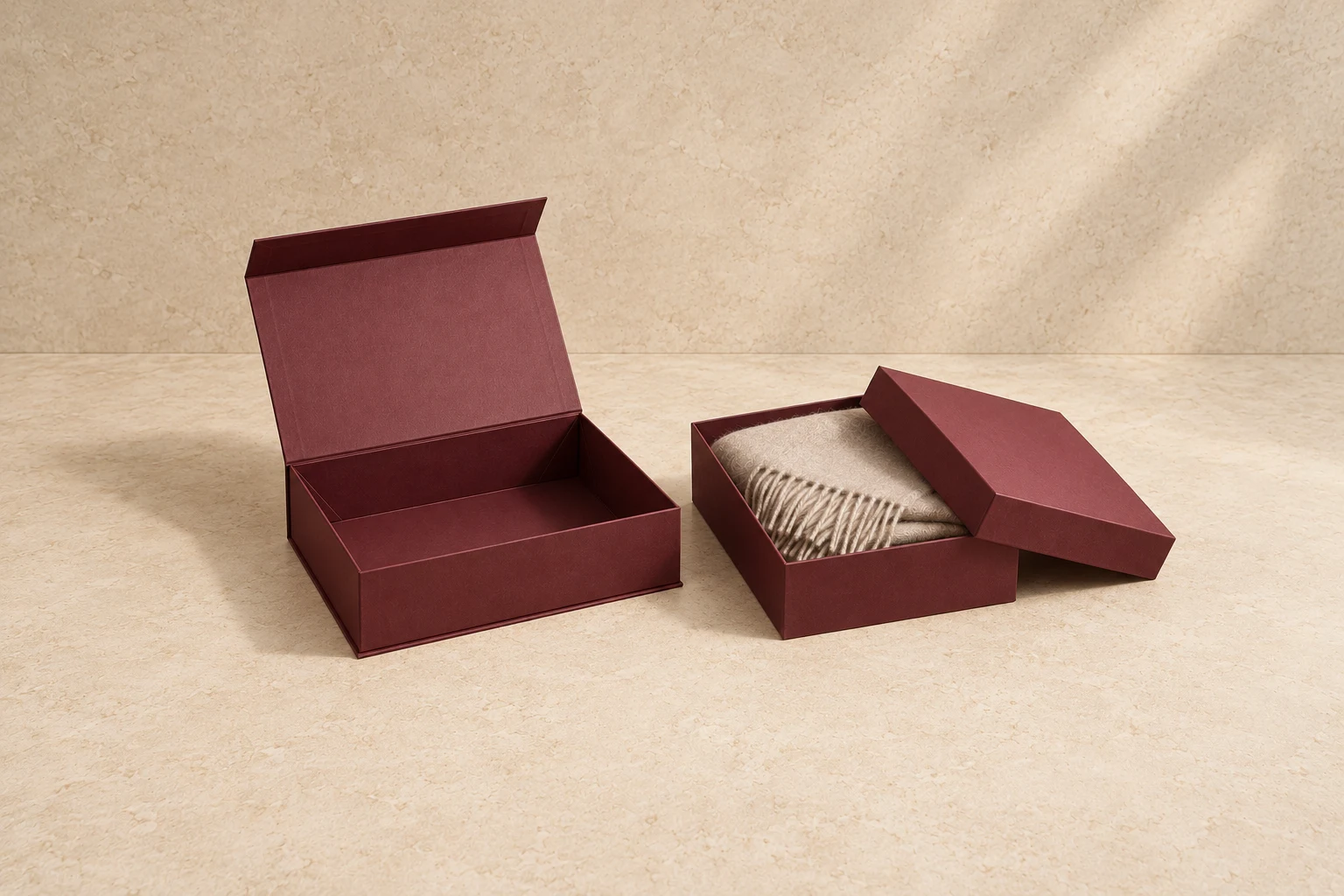
Compare a Triya Gift foldable gift box with an assembled lid-and-base box around the same product. If the design needs a magnetic reveal, specify the supplied state when requesting a magnetic rigid box. Keep the internal fit, insert function, print coverage and finish target aligned.
| Decision | Flat-pack rigid format | Assembled rigid format |
|---|---|---|
| Incoming volume | Measure collapsed bundles plus protective packing. | Measure cartons with actual packed box arrangement. |
| Local work | Erection, corner locking or bonding, liner disposal and shape checks. | Unpacking, inspection and any separate insert fitting still remain. |
| Inventory space | Lower profile may help; ask about storage billing minimums. | Full box volume remains until use; approved nesting may change it. |
| Final parcel | Measure again after erection, filling and outer protection. | Use the same finished-product packing scope. |
| Release condition | Check corners, squareness, closure and insert fit after assembly. | Check arrival damage, closure and insert fit. |
Separate incoming freight from customer delivery.
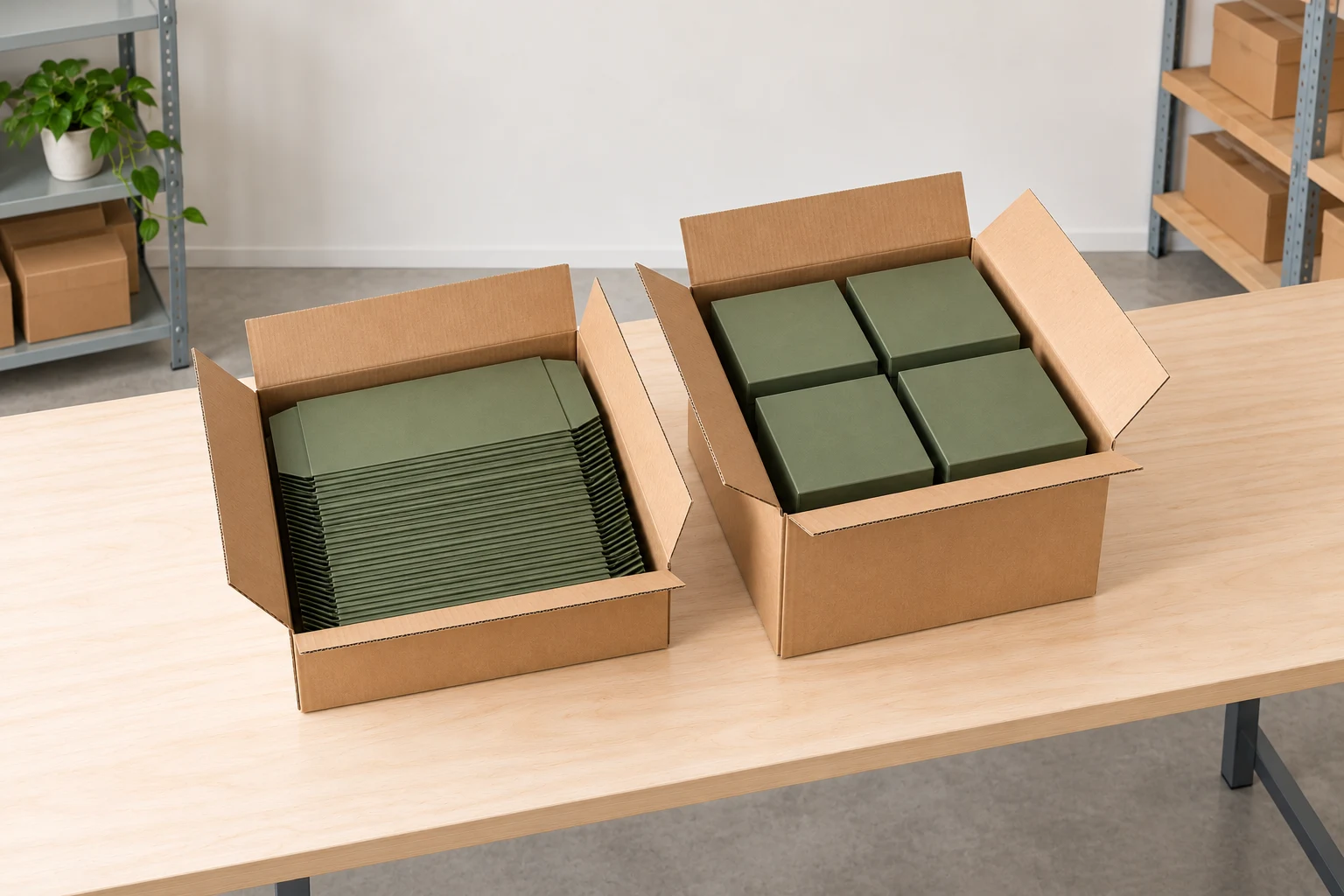
The first journey moves empty packaging to the packing site. The second moves the filled gift box to the buyer. A folded design can change the first journey without changing the second. Once both options surround the same product, their finished parcels may have similar dimensions.
For each incoming carton type, collect external length, width, height, gross weight and units per carton. Record full and partial cartons separately. For dimensions in centimetres, physical carton volume in cubic metres is L × W × H ÷ 1,000,000. Add the volume of every carton type; include pallet dimensions when the transport quote is pallet-based.
Do not turn a cube reduction directly into a freight-saving percentage. UPS explains dimensional weight as volume divided by a service-specific divisor. Actual billing also depends on the applicable service rules. Request two quotes for the same route, date, delivery responsibility and packing plan; do not assume one divisor or parcel rule applies to every shipment.
Ask the warehouse how it bills occupied space: actual cube, shelf position, pallet location or a minimum charge. A smaller shipment may still occupy the same billed location. Use the anticipated inventory drawdown over the comparison period, not the opening stock volume multiplied by an arbitrary number of months.
THE COMPARABLE COST
Total cost per usable box
(Boxes + setup + inbound freight + storage + local labor + consumables + rework) ÷ usable boxes
Use one currency and one scope. Add nonrecoverable landed charges where applicable and confirmed by your logistics adviser. Do not count supplier-included assembly twice. Exclude product purchase cost if identical for both options. Add outbound delivery only if the finished parcel actually changes.
Usable boxes are accepted boxes available for the agreed packing task, not simply the ordered quantity. Keep rejected units in the cost record without counting them in the denominator. If you compare equal usable outputs, include any replacement purchases needed to reach that output.
How many extra seconds can flat-pack afford?
First compare all non-labor costs per usable box. Call the assembled option's amount minus the flat option's amount D. Let R be the applicable labor cost per hour. If D is positive and both formats use the same labor rate, the extra time the flat format can absorb is:
Break-even extra seconds per usable box = 3,600 × D ÷ R
If D is zero or negative, flat-pack has no non-labor saving available to pay for extra assembly. If a packer charges per piece rather than by the hour, compare the actual per-piece fees instead. Minimum staffing shifts or overtime can make a smooth seconds-based estimate misleading.
Illustrative arithmetic, not a supplier quote
Suppose equal usable quantities give a non-labor saving of 0.20 currency units per box, and the relevant labor rate is 18 currency units per hour. Then 3,600 × 0.20 ÷ 18 = 40 additional seconds per usable box. A measured extra 30 seconds would cost 0.15, leaving 0.05 of that assumed saving. Extra 50 seconds would cost 0.25, exceeding it by 0.05.
These figures are chosen only to demonstrate the calculation. They are not Triya Gift pricing, a wage recommendation or observed production results. Replace every input with your quote and trial record.
Run a small trial before buying the saving.
This is a proposed buyer measurement method, not a report of internal test results.
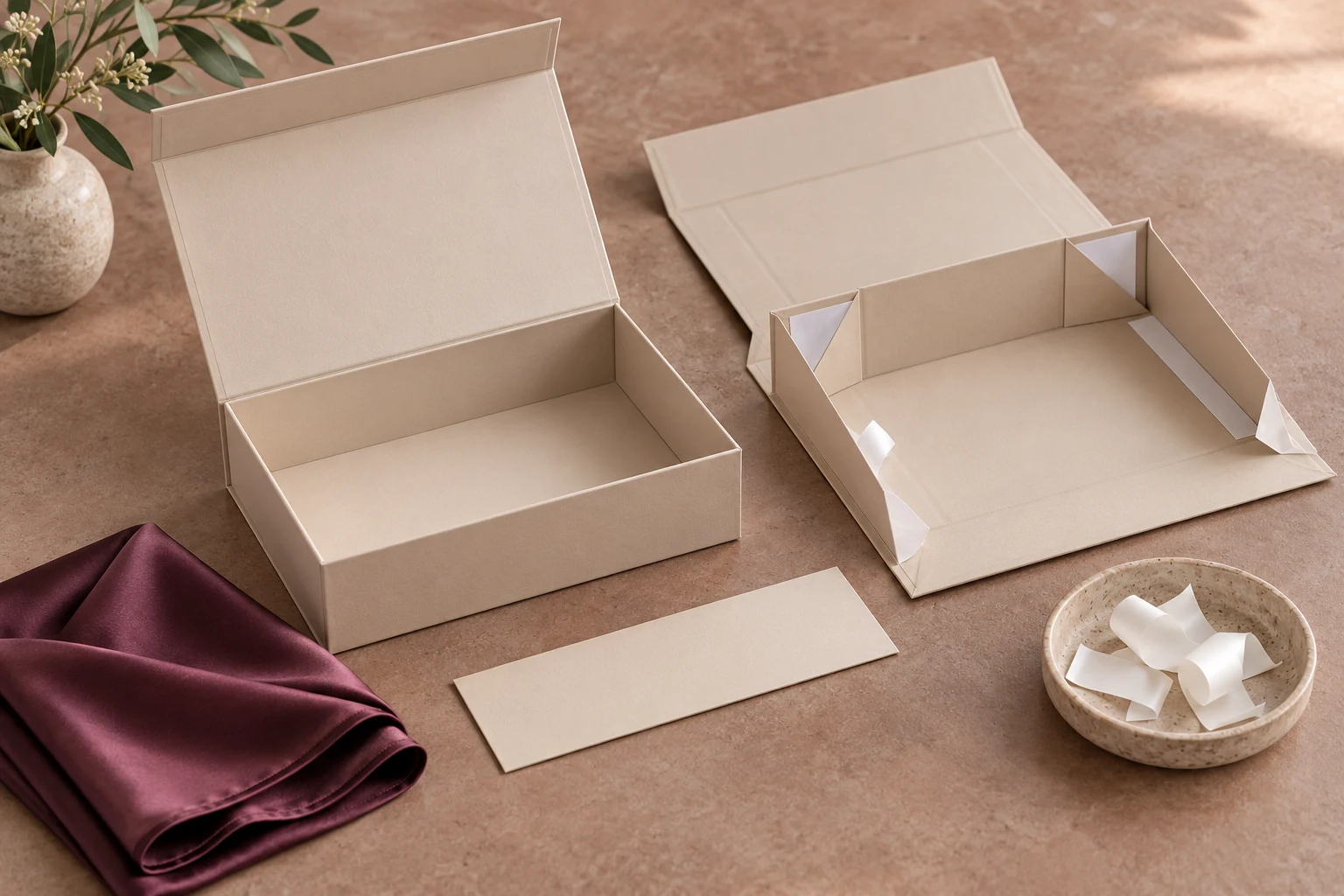
- Use production-representative samples. Confirm board, wrap, corner system, adhesive method and insert. Follow supplier instructions, including any required bonding time.
- Time comparable endpoints. Start with incoming packaging at the workbench; finish with an accepted box ready for the same product-loading step. Include unpacking, erection, insert fitting, checks and waste handling for both formats.
- Count labor minutes, not only clock minutes. Two people working for ten minutes contribute twenty labor minutes. Log setup and training separately; distinguish learning runs from repeated runs without hiding either cost.
- Record accepted output and exceptions. Keep the total time, accepted quantity, rejected quantity and rework reason for each run. Divide total labor seconds by accepted output; repeat with the people and conditions expected during normal packing.
- Check capacity as well as cost. Compare the observed range with the break-even limit and daily order demand. If the result is close, repeat the trial or request an assembled alternative before committing.
Save the sample revision, operator count, method, date and carton data with the calculation. Review gift box defect classification to define an accepted unit, and the supplier handoff guide to assign the assembly responsibility.
Buyer questions
Are collapsible rigid boxes always cheaper?
No. The box construction can cost more, while a space saving may occur elsewhere. Compare the complete cost at the same usable output and packing site.
Does flat-pack mean the customer receives a flat box?
Not in this comparison. The packer erects the gift box before filling and dispatch. Selling an empty flat box directly to a customer is a different route.
Is every magnetic gift box collapsible?
No. Magnetic describes the closure. Ask whether the specific construction is supplied assembled or flattened and request an assembly sample.
Can a foldable rigid box replace an outer shipping carton?
Do not assume so. Presentation-box construction alone does not establish parcel protection. Validate the product, insert and shipping protection together for the actual route.
What should we send for a two-option quote?
Send product dimensions and weight, target internal fit, artwork and finish, insert needs, usable quantity, packing location, destination and required date. Ask each option to state its supplied condition, master-carton data and assembly requirements.
ONE PRODUCT. TWO COSTED OPTIONS.
Ask Triya Gift to compare both constructions.
Share your product size, quantity, destination and where the boxes will be assembled. Request foldable and assembled options with equivalent presentation goals, separated setup costs and carton-packing data. Confirm MOQ, sampling and lead time for the actual specification.
Request a two-format packaging quoteExplore foldable gift boxes · lid-and-base boxes · all Triya Gift packaging