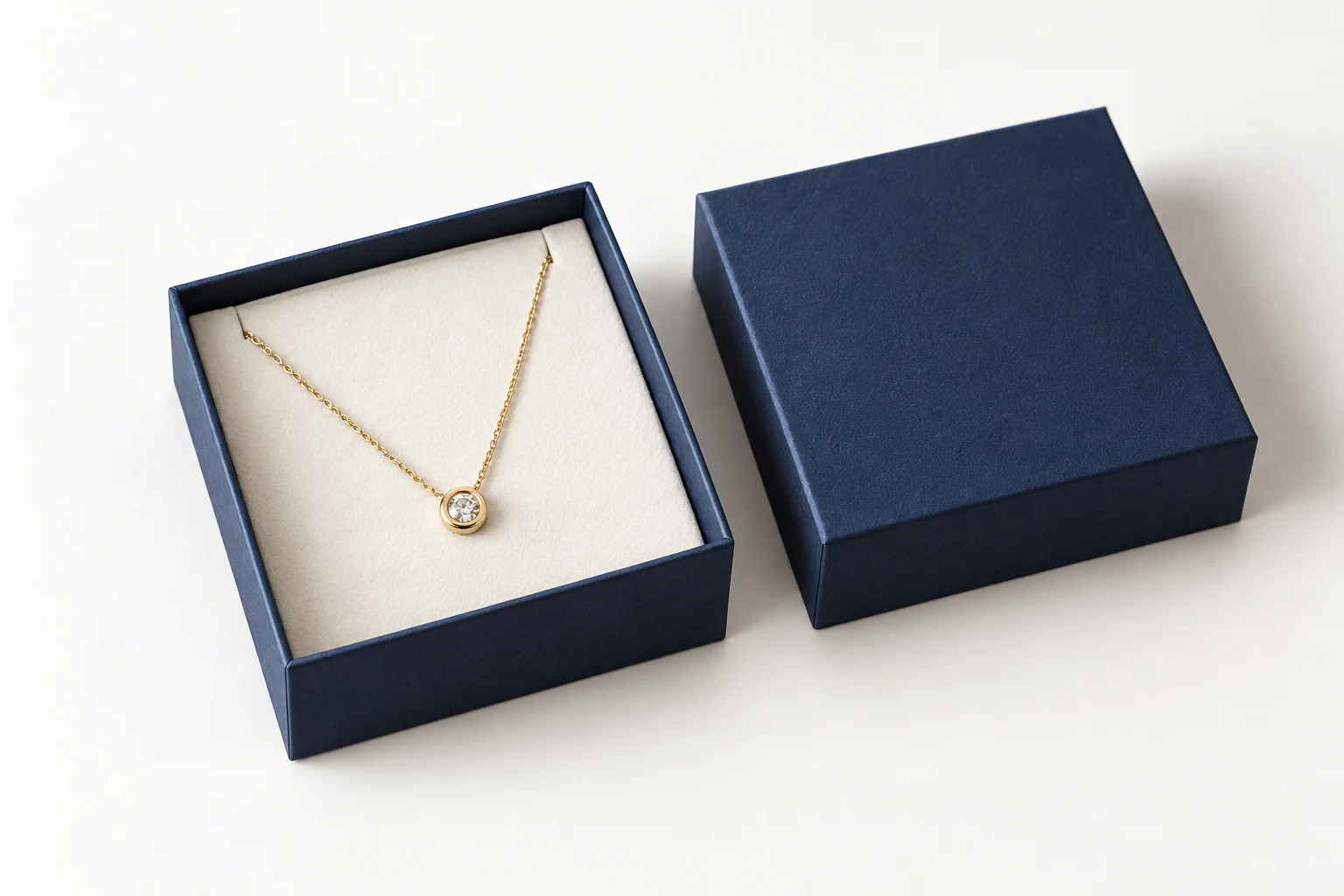
A gift experience is not a layer count.
Reddit conversations about jewelry presentation raise a practical tension: sellers want an order to feel special without spending excessively on materials, while buyers differ on whether elaborate wrapping adds value. In discussions about order packaging, some appreciate personal touches and others dislike disposable extras. These individual accounts help frame a design question; they do not establish a sales uplift or a universal customer preference.
For a jewelry brand, start by separating three jobs. The insert positions the piece. The gift box presents it. The shipping pack protects that presentation on its journey. One attractive box does not automatically perform all three jobs.
Scope: paper-based presentation packaging for necklaces, earrings, rings and small accessories. This guide is not a certified transport test or a guarantee of long-term tarnish protection. Check materials and storage requirements against your actual jewelry.
01 / START INSIDE
Measure the piece, then design the hold.
A necklace can fit within a box and still move around inside it. Record the pendant's maximum width, height and thickness, the chain length and the position of the clasp. Plan where excess chain will sit so it is not trapped beneath the lid or allowed to rub against the pendant. Check removal with the actual piece rather than approving an empty box.
For earrings, record post length and back dimensions as well as the visible design. A display card needs clearance behind it; a beautiful shallow box can become unsuitable if closing it presses on the posts. For rings, check that the chosen slot holds the band without forcing the setting against the lid.
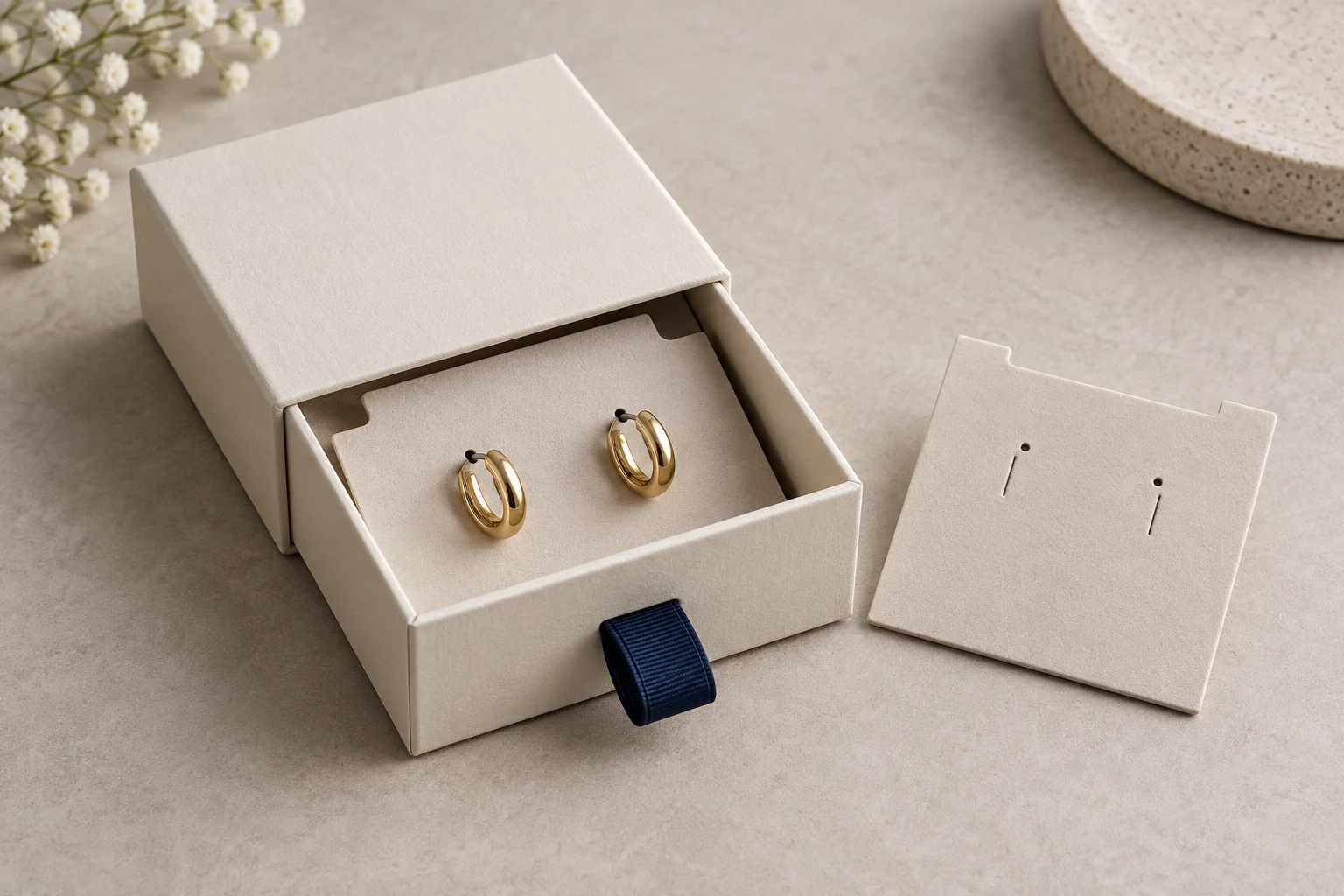
Discuss removable cards, paperboard platforms or lined inserts with your supplier. “Soft” describes feel, not verified chemical compatibility. If you require an anti-tarnish material, request evidence for the exact material and intended use rather than assuming a fabric lining provides that function.
02 / CHOOSE THE OPENING
Two box formats. Different decisions.
| Format | Useful starting point | What to check on a sample |
|---|---|---|
| Sliding drawer box | A card-mounted pair of earrings or compact accessory with a pull-out reveal. | Drawer travel, pull-tab attachment, insert movement and whether the jewelry catches during opening. |
| Lid-and-base box | A pendant, ring or small coordinated set presented from above. | Lid clearance, opening force, insert removal and contact with raised settings. |
| Magnetic rigid box | A larger coordinated gift set that needs space for multiple items. | Whether the added footprint is justified and the closed lid leaves every component clear. |
These are design starting points, not universal assignments. Two necklace styles may need different inserts even when they share one outer box. Ask for the insert and box to be sampled together.
Make everyday and gifting packs deliberate.
If some orders are gifts and others are repeat purchases, consider two clearly described packing options. Keep the retention and delivery protection appropriate in both. The gift option might add one presentation box and a message card; it does not need a second pouch, a wrap, a ribbon and loose decoration by default.
Compare the complete packing operation, not only the empty-box quote. Record the cost of the box, insert, card, outer pack and assembly time using your actual supplier quotes and a timed packing trial. A cheaper component that takes longer to assemble may not be the lower-cost finished pack. Do not assume a gift upgrade improves conversion without testing it in your own store.
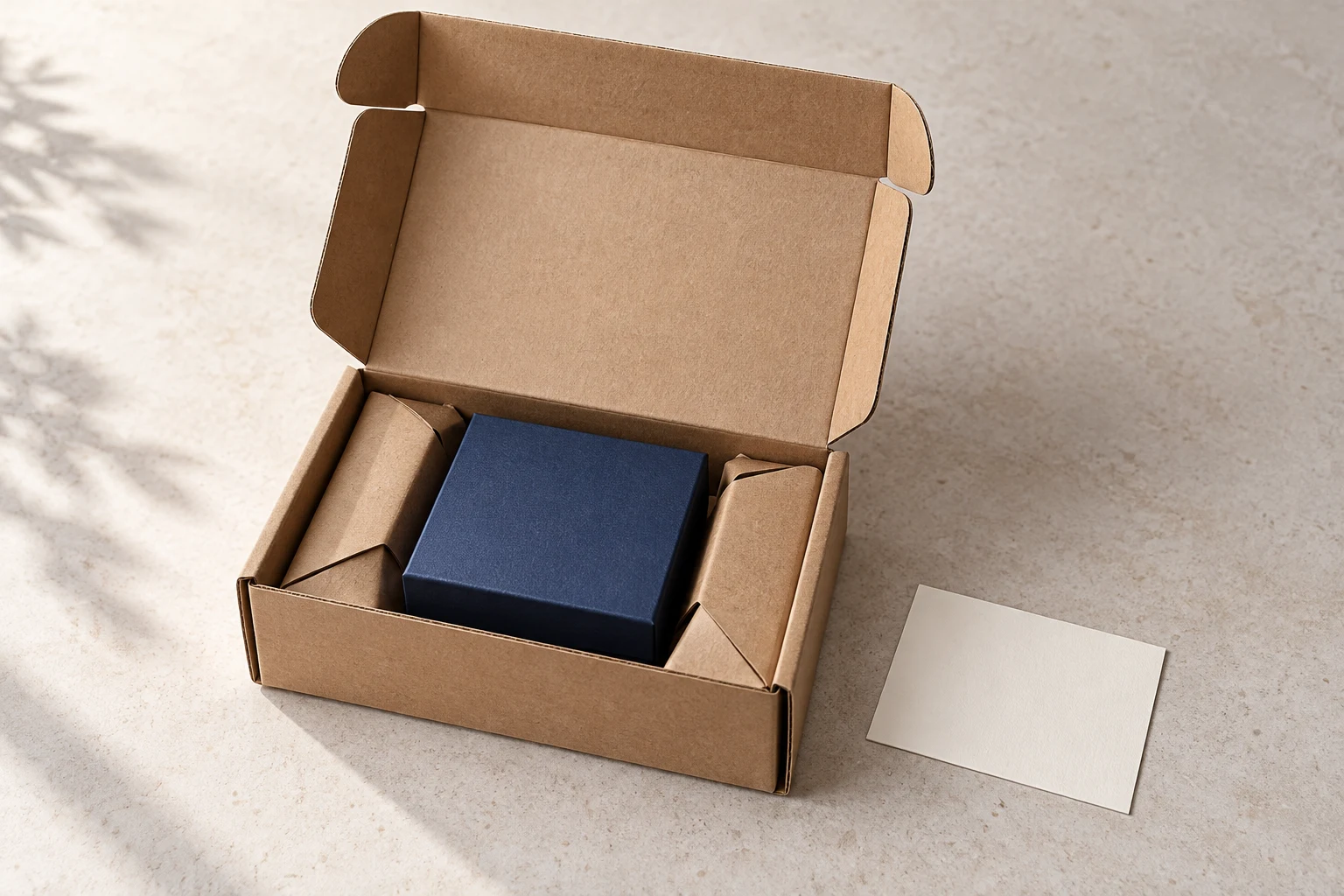
For parcel orders, review the outer mailer separately. Check that the gift box cannot slide freely, the cushioning does not distort its lid and the recipient can remove it without damage. Do not use a presentation-only sample to approve the shipping system.
03 / A REPEATABLE REVIEW
Approve a packed sample, not an empty promise.
Use this proposed review method with your supplier. It is a documentation workflow, not a substitute for an agreed distribution test.
- Identify the configuration. Record jewelry SKU, measured dimensions, box size, insert revision and all packing components.
- Photograph the starting condition. Capture chain routing, earring backs, lid clearance and the closed outer pack.
- Check handling and opening. Gently change orientation and open the sample. Record displacement, snagging, marks and ease of removal. Agree acceptance criteria before testing.
- Evaluate the delivery route. Agree suitable transit testing with your supplier or a qualified laboratory for the actual product, package and route. Record the method and results.
- Repeat after changes. A different chain, insert surface or box depth may change performance. Retain the approved sample and revision photographs.
For the quote, send product photos, measurements, quantity options, intended gift experience and destination. Ask the supplier to separate box, insert, tooling, sample and shipping costs. MOQ and timing should be confirmed for your chosen specification, not copied from an unrelated project.
COMMON BUYER QUESTIONS
Before you brief a supplier.
Does every jewelry order need a rigid gift box?
No. Match the pack to product fragility, recipient expectations and the delivery route. A gift-ready rigid box may suit some collections, while a simpler presentation can suit others. Retention and protection still need verification.
Can one box serve necklaces and earrings?
Possibly, with different inserts and enough clearance for each SKU. Sample both configurations; shared outer dimensions do not prove that every item is held safely.
Will a velvet-style insert prevent tarnishing?
Do not assume so from appearance. Ask for the actual material specification and evidence supporting any protection claim, and follow the jewelry maker's storage guidance.
How can Triya Gift help?
Explore our custom jewelry packaging, then send your product dimensions and presentation brief. We can discuss box structures, insert options and sampling requirements for your project; availability, pricing and timing need confirmation against the final specification.