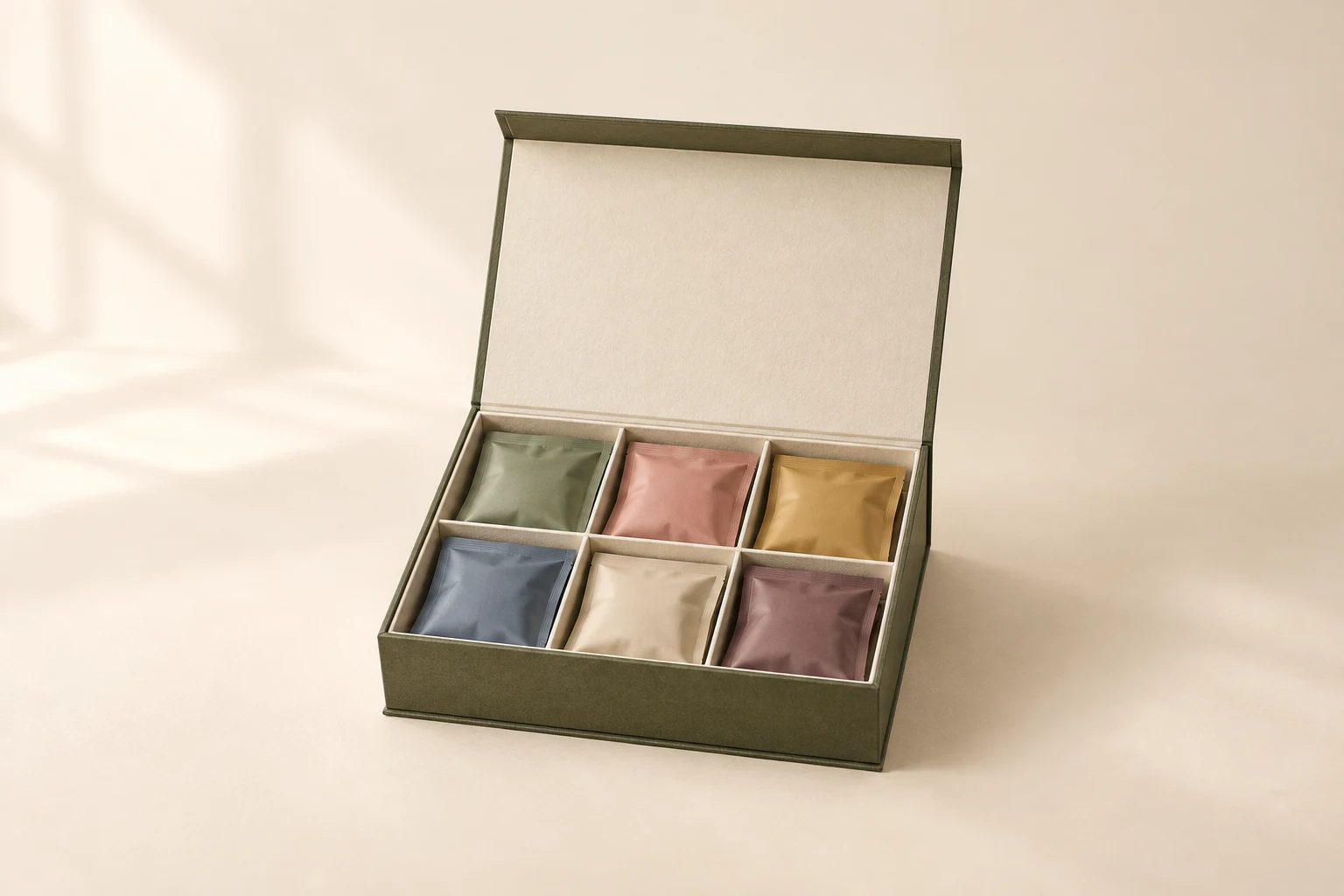
Start with the tasting experience.
In Reddit tea-sampler discussions, people ask for variety before committing to larger purchases. Gift buyers also ask for help choosing an assortment for someone whose preferences they may not share. These are useful qualitative design prompts, not evidence that one box format will sell better.
A sampler should make three tasks straightforward: identify a tea, remove its pack and find it again after tasting. Decide whether the collection explores one family of teas or introduces several different styles. That decision shapes the assortment map and presentation order more meaningfully than simply filling every available compartment.
For a first-time recipient, include preparation instructions supplied or approved by the tea brand. Keep the tea name on the primary pack as well as the tasting card, so identification survives after the contents are removed. Do not rely on color alone to distinguish varieties.
Scope: secondary paper gift packaging around already packed tea. Primary-pack suitability, sealing, product labeling and shelf-life validation remain separate requirements for the tea brand and its packaging specialists. This guide does not certify a food-contact material.
01 / DESIGN FROM THE INSIDE OUT
Measure the filled pack, not the empty pouch.
A flat pouch drawing is not the same as a filled pouch. Record maximum width, height and thickness in the orientation intended for the gift box. Include gussets, zipper areas and seal edges. Compare actual samples across the intended assortment; leaf shape and fill quantity can change how a pouch sits.
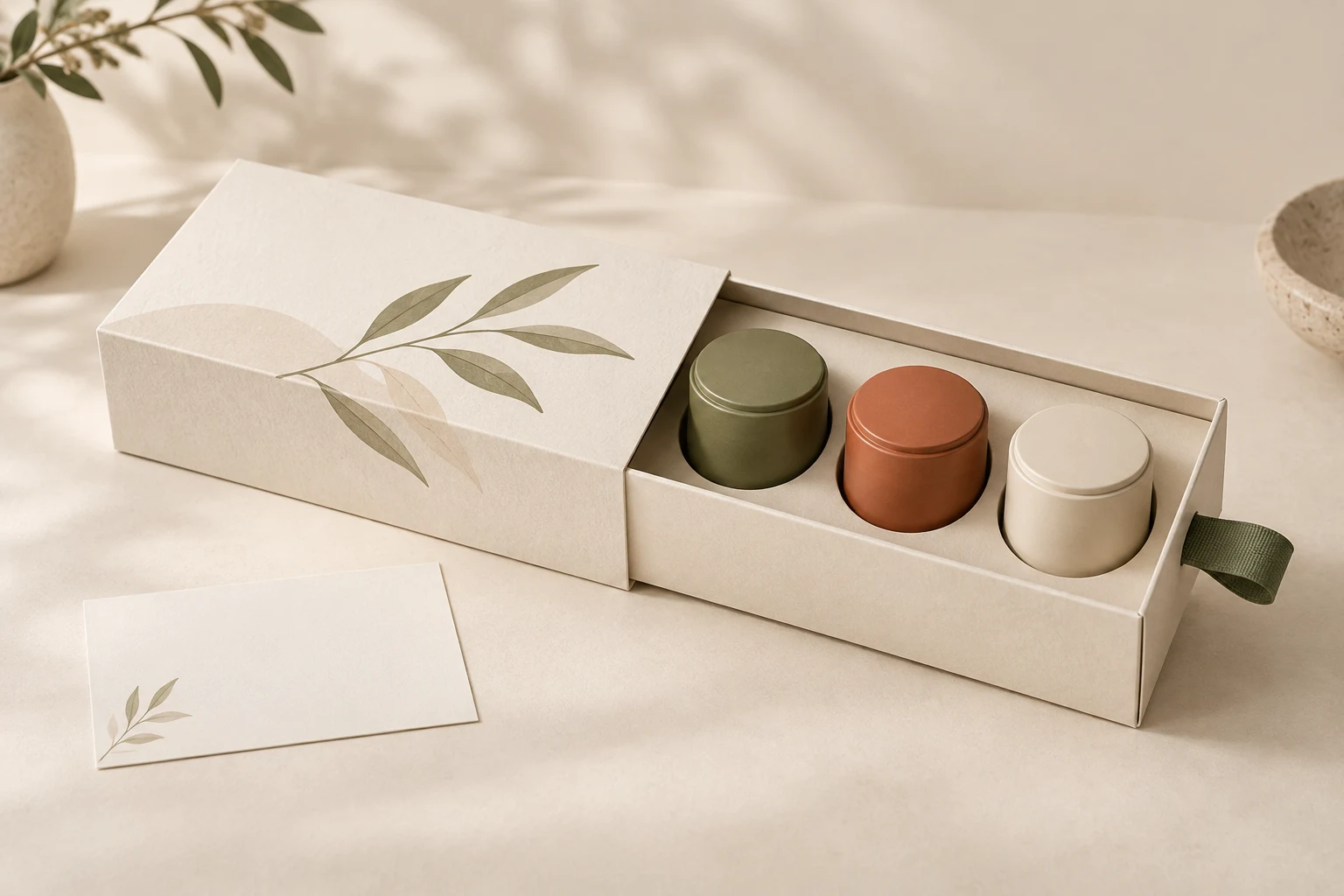
For tins, measure the closed container including lid overhang and any label seam. Decide whether customers lift each tin straight up or pull it from a drawer. Leave a deliberate way to grip it rather than requiring a tight fit that looks tidy but makes removal frustrating.
| Primary pack | Record | Check in the mock-up |
|---|---|---|
| Flexible sealed pouch | Filled dimensions, seal position, quantity per compartment | No pinched seams; easy removal; neighboring packs stay in place |
| Closed tin | Outside dimensions, lid overhang, packed weight | Finger access; lid clearance; no excessive movement |
| Mixed assortment | Separate dimensions and orientation for every item | Each position is intentional; one item cannot displace another |
Use these measurements to develop a trial layout. Do not add a universal clearance number to every product: the board, insert design and primary-pack variation all affect fit. Confirm dimensions against a physical sample.
02 / MATCH THE BOX TO THE COLLECTION
Choose how the assortment opens.
| Structure | Suitable design direction | Sample question |
|---|---|---|
| Magnetic rigid box | An overview of individually packed teas presented together | Can the lid close without pressing on the tallest pack? |
| Sliding drawer box | A controlled reveal of a compact tin or pouch collection | Does the loaded drawer move smoothly without catching the contents? |
| Lid-and-base box | A top-access assortment with a removable divider | Can the recipient lift the lid and retrieve every pack comfortably? |
The box does not determine the tea's freshness. Neither a magnetic closure nor a snug paper insert establishes a barrier specification. Keep the primary-pack performance brief separate from the presentation brief, and do not describe an untested gift box as airtight.
Triya Gift's paper box range provides starting structures for a custom brief. Exact dimensions, insert configuration, surface finish and sampling arrangements need confirmation for the selected assortment.
Build an assortment map that survives unpacking.
Give every tea a distinct, readable identity. A tasting card can show the collection order, tea names, brand-approved preparation guidance and a place to note favorites. If a QR code leads to a product page, test the destination on a phone and plan how that link will remain useful when a seasonal product is no longer available.
For changing collections, consider keeping the outer box consistent while revising the insert and card. This may simplify artwork management, but it does not guarantee that a new pouch will fit the old compartment. Review each assortment revision before packing starts.
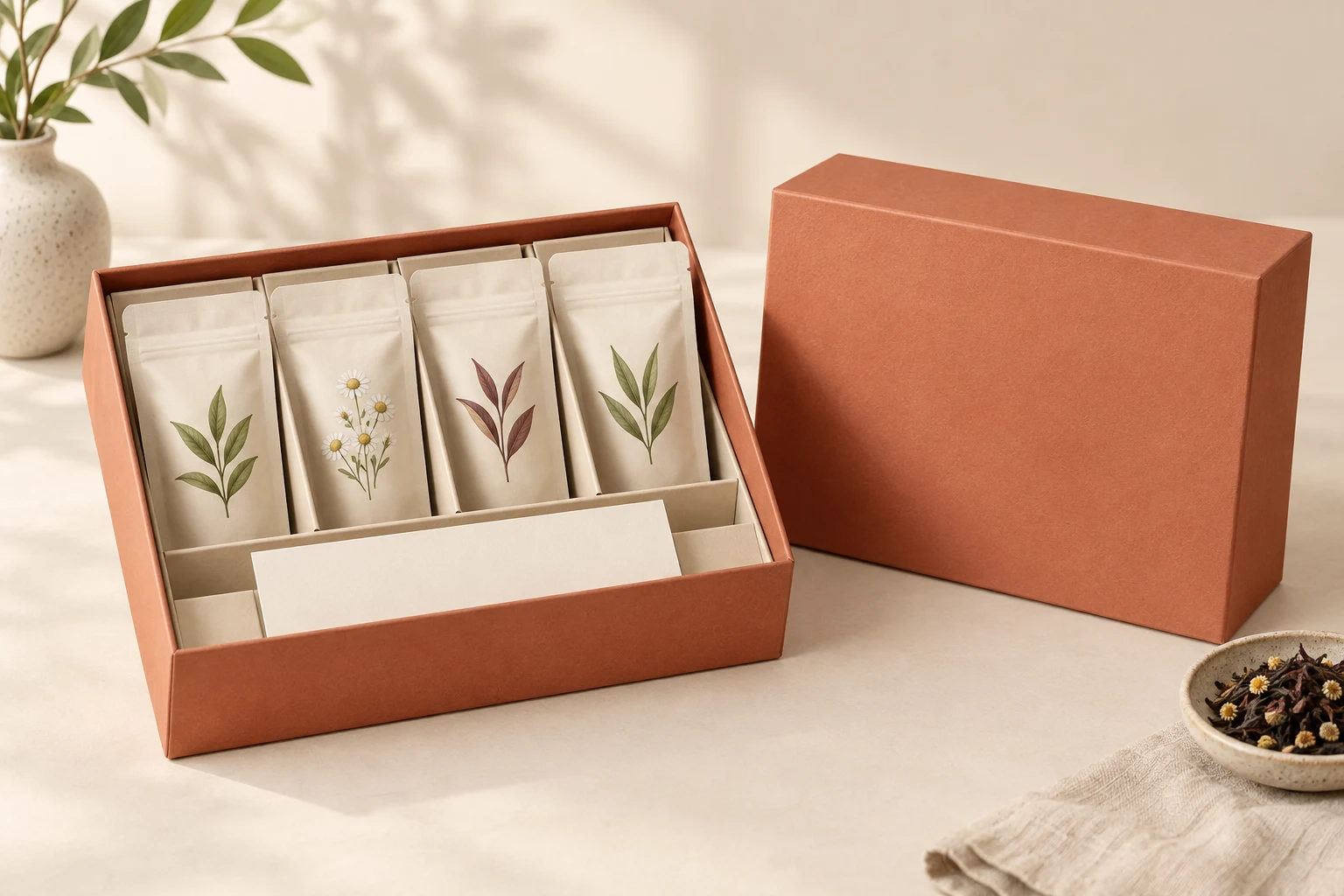
Separate a gift assortment from a subscription pack in the brief. A retail gift may need a complete introduction on first opening. A repeat subscription may prioritize quick identification of that month's selection. Use the actual customer's task to decide whether a permanent divider, a removable tray or a simpler arrangement is appropriate.
03 / PROPOSED INTERNAL REVIEW METHOD
Trial the complete collection.
This practical workflow produces a record for sample approval. It is not a laboratory transport or shelf-life test.
- Record the configuration. List tea SKUs, primary-pack measurements, box dimensions, insert revision and the card artwork version.
- Load actual filled packs. Photograph their positions. Note any bending, seal pressure, unstable tins or blocked identification.
- Check access. Ask a reviewer to identify and remove each pack using the included information. Record points of confusion instead of assuming the assortment is self-explanatory.
- Check the fully loaded closure. Look for contact with tall items, drawer resistance and movement during gentle handling. Agree acceptance criteria with the supplier.
- Review dispatch packaging. If the set will ship by parcel, sample the outer mailer and protection together. Agree appropriate distribution testing for the actual route.
- Approve a controlled version. Retain the sample, photos and measurement record. Repeat affected checks when contents, insert material or dimensions change.
Where packing efficiency matters, time several complete packing cycles and record the number of trials, operator and configuration. Use that observation for your own planning; do not present an isolated trial as a general production rate.
Prepare a quote that matches the assortment.
Send Triya Gift photographs of the filled pouches or tins, their maximum dimensions and weights, the number of varieties, quantities per variety and a preferred opening style. Add order quantity options, artwork status, delivery destination and required arrival date.
Ask for the box, divider, printed card, tooling, samples and freight to be identified in the quotation. Confirm whether a changed assortment needs new tooling or only revised print files. MOQ and production timing depend on the final specification; do not transfer figures from a different gift set.
If you need a parcel-ready package, include that requirement from the start. Our custom mailer boxes can be discussed as an outer layer, with the fit and protection verified using the loaded gift box.
COMMON BUYER QUESTIONS
Before the first sample.
How many teas should a sampler box contain?
There is no universal count. Choose the tasting purpose and intended serving quantities first, then develop a layout around the filled packs. More compartments are not automatically a better experience.
Can loose tea sit directly in a paper gift-box compartment?
This guide assumes separately packed tea. Do not treat a decorative gift box or divider as approved direct-contact packaging. Confirm the primary packaging and intended use with the responsible supplier.
Can a drawer box hold both tins and pouches?
Potentially, using a layout developed for both. Test loaded drawer movement, weight distribution, grip access and seal clearance with the actual products.
Can the same box be used for a later seasonal collection?
Possibly, if the revised contents still fit and the artwork remains accurate. A replaceable card or sleeve may offer flexibility, but review dimensions and identification every time.